Download the 2011 Excel spreadsheet (in German) of camps and camp info: AustriaCampsV7.xls provided by Klaus.
Absam district (Gnadenwald?) - Wiesenhof camp; French zone
Absam-Eichat - Solbad Hall; French zone
Admont has its own page, at Enns River; Land Steiermark; British Zone; in Styria, 2000 Jews; two camps; UNRAA 314, 334; See also Frauenberg DP camp.
Alberschwende, at
Bregenz, Land
Vorarlberg, French zone
Municipal office: Gemeindeamt Alberschwende
Hof 3
A 6861 Alberschwende
(this place is in near from Dornbirn)
Tel: +43 5579 4220-0
fax: +43 5579 4220-9
Email: alberschwende@gemeindeam
This is a computer translation: "Pursuit and resistance in Vorarlberg 1933-1945, was published by the Johann August Malin Society in 1985. The book treats for Vorarlberg for the first time in detail and comprehensively pursuit and resistance under "staendestaatlichen" Regime (of the elimination of the federal parliament in March 1933 up to the National Socialist seizure of power in March 1938) as well as under the LV dictatorship from March 1938 up to the end of war at the beginning of of May 1945. The encyclopedia contains data to persons, who had either their regular domicile between 1933 and 1945 in Vorarlberg or by their origin were bound to the country. Where necessary, the data on the basis of new research results were updated. "
Alleestrasse - Köflach; British zone;
Alpenstrasse - in Salzburg, stadteil Salzburg Süd; former NS-Baracker, Jews
Alserbachstrasse - 9th district Alsergrund; Wien, IX; US zone;
Alstadt - Salzburg
Andritz - in Graz; British zone;
Ansfelden - see Haid; Linz, US zone;
http://www.theatrelibrary.org
Anif b Salzburg; US zone;
Artilleriekaserne - Konradkassern; 58/73; in Steyr; 231; Linz; US zone;
Arzbergegasse - Nr. 2; Wien, XVII (Hernals);
Ast u. Co. - Graz
Astatt Lochen - 603; US zone;
Asten - 117 V5; Land Upper
Austria, U.S. zone; See also Linz archives. UNRRA Team 339,
Resettlement centre,
Asten, Aged unit,
Asten, Chronic sic unit,
Municipal
office:Gemeindeamt Asten
Marktplatz 2
A 4481 Asten
Tel: 0043 7224 66381
- 0
Fax: 0043 7224 66381 - 24
Email: gemeinde@asten.ooe.gv.at
Hello,
I have finally found the web
site that I have been searching for, but I need help. I was born in Asten
Resettlement Camp near Linz, Austria in 1946.
I was born to Marija Glavasevic and Joseph Lickert (later name change to Hancl).
My mother and I resettled in the USA in Sept. 1949 and my birth father and
his family resettled in Australia in 1949 also. Could you give me a few leads
on how to reseach more information on Asten DP camp?
Can I request copies of status sheets, medical info, indentity papers, or any other info relating to our stay in Asten Camp, from any agencies in the USA or Austria?
My mother is now 80 years old and she cannot remember dates and names of places during the war years and post war years. Please, ANY information you can find for me will be greatly appreciated.
Thank you, Alex GlavasevicHi Alex and Olga,
was born in Asten and lived in the DP camp for 5 years. My family emigrated
to Winnipeg, Canada. In fact, more than few Ukrainians and Poles from
Asten ended up in Winnipeg, Canada. In 1975, I visited the former camp,
which is now a prison. I also found my sister's baptismal records at
the Asten Catholic church.
I'm a sociologist and educator, currently living in Shanghai. For some time I've been thinking of getting in touch with others who were born in that camp. Maybe this could be a start. I'd like to find out what happened to them...what their lives have been like etc. Do you know any others from that place and time?
I know that my mother has some pictures from her time at Camp Asten, so when I return for a visit I will try to get these scanned for your site. But that will probably not be until next May. My family name is Zajac. There are four girls in my family. Two of us started our lives at DP Camp Asten. I hope my invitation to hear from people born in Asten draws answers via your site. Will let you know what comes of it.My highest regards to Olga
Kaczmar for the monumental labor of love!
Cheers, Bohdanna donnapankiw@yahoo.com
Dear Olga,
I was happy to find your page. Please accept my apology for my bad English
and bothering you with this message. I am a 75 old Hungarian Jew living
in Costa Rica since 1949.
After years of searching for my family I have received yesterday a formal communication from the Red Cross International Tracing Service stating that my sister, EVA, born in Szigetvar (Hungary) and deported first, with my mother, to Auschwitz, transfered to Stutthof on 20th July 1944 was registered the 5th of March 1949 in Asten DP Camp /Austria. After this date no further records was found.
Now I intend to find out whether she is still alive and of course how can I contact her or anybody who can give me some information about her actual or past whereabouts. Can you help me with some advice what shall I do?
I will be profoundly grateful
to you for your kindness,
Sincerely, Etienne (Istvan)
Somogyi
(San Jose, Costa Ricab
etiennesomogyi@sonivision.co.cr
somogyi@amnet.co.cr
Book: Death
marches of Hungarian Jews
by Eleanor Lappin
Forced
workers text in German
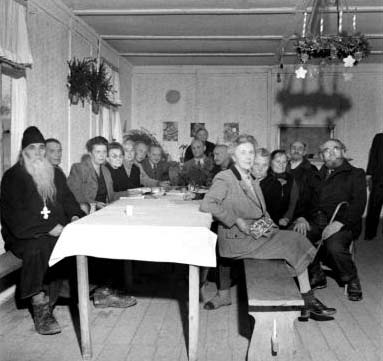
DP residents in dining hall, Christmas 1949.
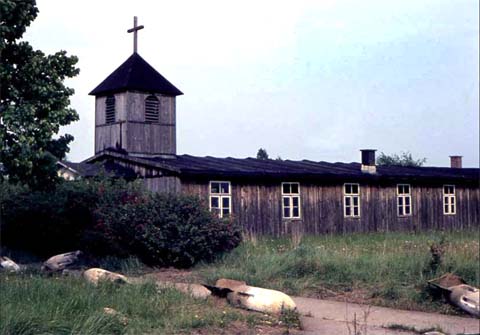
Photo source: Virtual Museum of Upper Austria
Aug 6, 2020 petra simne wrote:
Hello Olga, my name is Petra Simic Jelisic, I have information that indicates that my father Gvozden Simic and my mother Angelina Simic were from 1944 to 1948 at D. P. Camp. St. Johann and Camp Asten.
My sister Maria Mara Simic Jelisic was born in St. Johann, Pongau, Austria in 1947. She was born to Angelina Jelisic and Gvozden Simic.
Please, any information you can find for me will be greatly appreciated.
Thank you, Petra Simic petrasimne@gmail.com
Auenwiese 1-10 - Kapfenberg; British zone;
Auslånderlager - foreigner camp or unloading warehouse; in Kufstein
Bad Gastein - 96 Badgastein; (at Pongau province) considered luxurious (use of different hotels...), Jews, UNRRA Team 322, Land Salzburg, permanent camp, US zone;
Municipal
office: Gemeindeamt Bad Gastein
Kaiser Franz-Josef-Strasse 1
A 5640 Bad Gastein
Tel: 0043
6434 3744 - 0
Fax: 0043 6434 3744 - 33
Email: gemeindeamt@bad-gastein.at
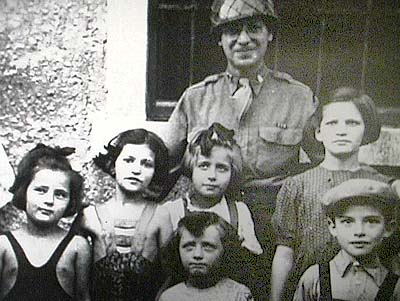
Right: Chaplain and children, 1945
Photo source: National Museum of American Jewish Military History http://www.nmajmh.org/
Photo supplied by Klaus
Fohringer Austria
Photo credit www.Ak-center.de
See USHMM web exhibition: http://www.ushmm.org
Aug. 6, 2020 Dear Olga,
I am searching for a name-list of UNRRA-Team 322 in Austria. The UNRRA-Team 322 served at Innsbruck and Bad Gastein.
Best regards, Thom G. Lackner, Verbal Turbulence Jerrys FirstSouthArt@hotmail.com
Austria
Bad Hall - LInz; Kinderspital [children's hospital] & Gastr; US zone;
Bad Hofgastein - near Badgastein, hospital, US Zone, Jews
Bad Ischl - in Salzkammergut province; Jews, Russian (probably Ukrainians misnamed); US zone;
City Archive: Stadtarchiv Bad Ischl
Pfarrgasse 11
A-4820 Bad Ischl
Tel: +43 (6132) 233 4151
Fax: +43 (6132) 233 4111
http://aufbauonline.com
(about Bricha routes to Italy)
3/17/05 Hello Olga,
I discovered your website about DP Camps in Austria with delight. My family, Andrew and Anna Vinogradov (now Vinson) and I escaped from Prague in 1944 when I was 1 year old and traveled to Salzburg/Parsch and then to Bad
Ischl where an acquaintance of my father's, Nicolai Makarov, had a house and was building roads for the semi-infamous Organization Tod. Makarov was subsequently arrested for maltreating Jewish forced labor workers, and we lost all track of him. We lived in Bad Ischl during 1944-1948.
My father worked for UNNRA in Strobl and also as an interpreter in Russian/Czech/German/Polish/English for the US Army when it rolled into Bad Ischl. Franz Lehar was a famous resident, of course, and my father was able to dissuade the US Army authority from confiscating his limousine. I almost drowned twice in the Rettenbach and Salzach rivers before I was two, was saved once by a fugitive German Waffen-SS soldier who was hiding in the woods across the water, and attended the local kindergarten. We lived in the apartment building of the wealthy Frau Palmersberger, on Kreuzplatz. I've gone back and visited Bad Ischl in 1969 and 1975, but the apartment bldg. is now an Esso gas station.
My father one day discovered some old court newspapers, Hofnachrichten, stuck in a de-plastered wall, and gained a window into the past about the daily events at the Kaiserpark of Emperor Franz Josef, who of course stayed in Bad Ischl every summer for some 50-odd years hunting gamsbok. My father also learned amazingly much about Bad Ischl in the 1800s, with regular visits by Russian nobility, etc. Unfortunately, he passed away with all his memories three years ago at the age of 88.
Cordially yours, George Vinson, geo.vinson@sbcglobal.net Turlock, California
Bad Kreuzen - Frijof Nansen-Heim; Perg district; Swiss zone;
Bad Schallerbach Children's
Home, Landösterreich, Upper Austria, Wels; Leitendorf, Team 314; U.S. Zone;
Municipal office: Gemeinde Bad Schallerbach
Rathausplatz 1
A 4701 Bad Schallerbach
Tel: 0043 7249 48555 - 0
Fax: 0043 7249 48555 - 22
Email: gemeinde@bad-schallerbach.at
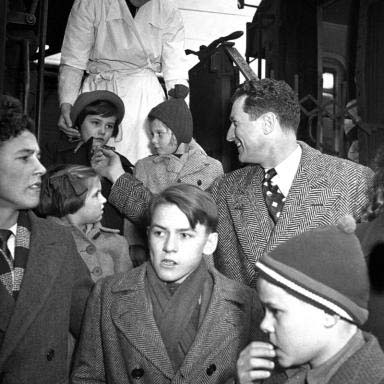
1951,
Photo source: Austrian Picture Archives http://www.bildarchiv.at
FL Bad Schallerbach 1946-50, Kinderheim Leitendorf
Photo source: USHMM Photos supplied by Klaus Fohringer
Badgastein - Pongau province, Salzburg Team 322 US Zone;
Bahnhofstrasse - Leoben; British zone
Bahnhofviertel - Murau; British zone;
Bårnbach - Kohle und Erz, GKB Barracks, Marienschacht; British zone;
Baron Schwarz Park - Salzburg; Itzling; Vogelweidenstrasse t; 3 barracks 1952
Bauleitung - Villach, Ghonallee, British zone;
Behelfsheim 1-10 - Neumarkt; British zone;
Behelfssiedlung - Knittelfeld; British zone;
Bergmillerg. 2 - Wien XIV,
Beth Bialik - Stuberkaserne; Klessheimer Allee 51; Land Salzburg alt-Maxglan ; City of Salzburg - See Salzburg archives. It was the American Red Cross DP camp in Austria;. U.S. Zone; See: salzburg.html
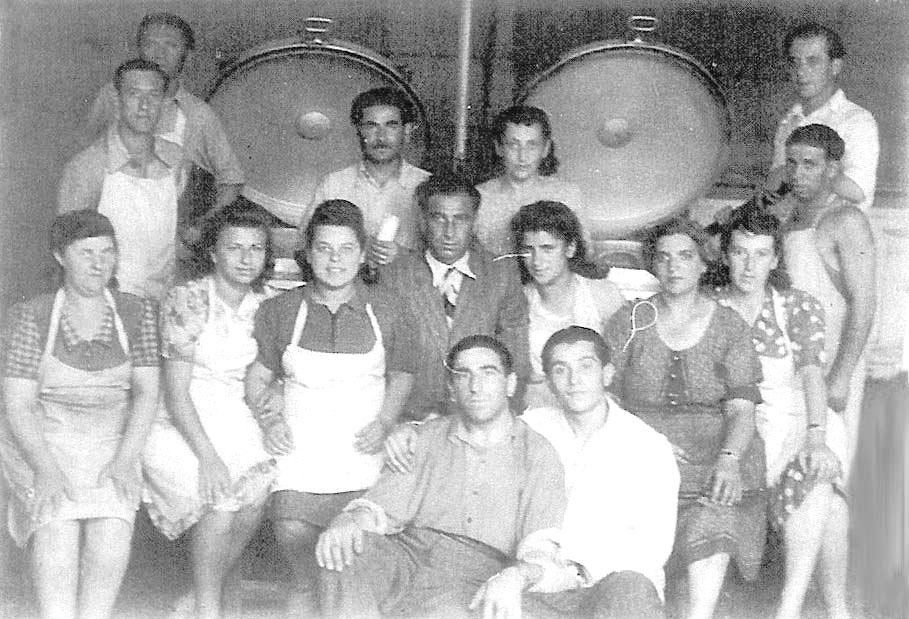
Beth Bialik 1946; source: Yad Vashem Kitchen staff of Beth Bialik
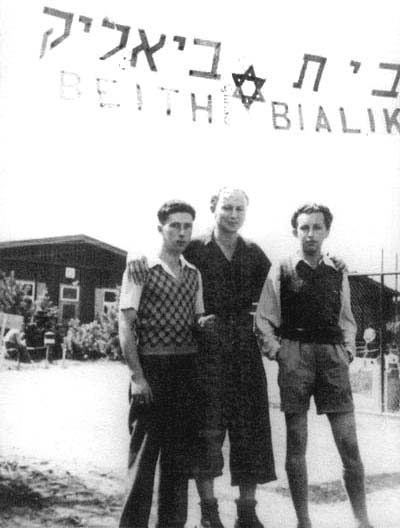
Beth Bialik 1946; source: Yad Vashem Kitchen staff of Beth Bialik
2/13/05
Thank you for your information from Austria. With your list
of DP camps, they were able to identify the camp they were in in Salzburg:
Beth Bialik. I have several photos now of that camp and people from another
DP camp in the area that they visited to see friends. We can identify
many people in the photos, but perhaps others who are looking for photos
from the camps, can identify themselves as well. Here are the first two
photos: I do know some of the people in these photos are the Gilner
family from OSTROW MAZOWIECKA, Poland. My mother-in-law and her family are in both photos.
They were taken at a wedding in the DP camp Beth Bialik. Karen
Salver ksalver18@gmail.com
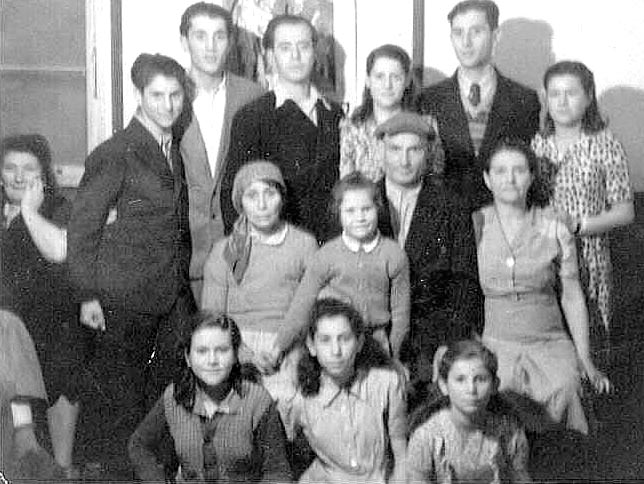
Gilner family
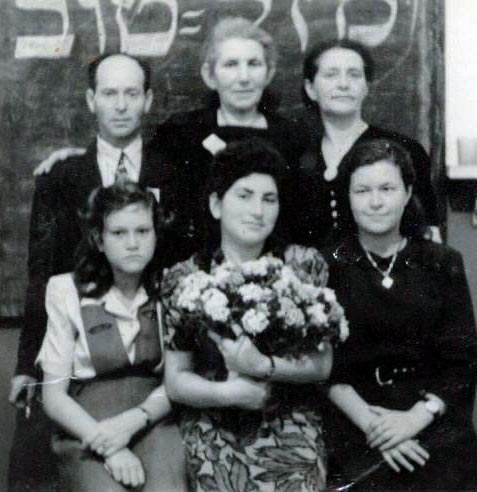
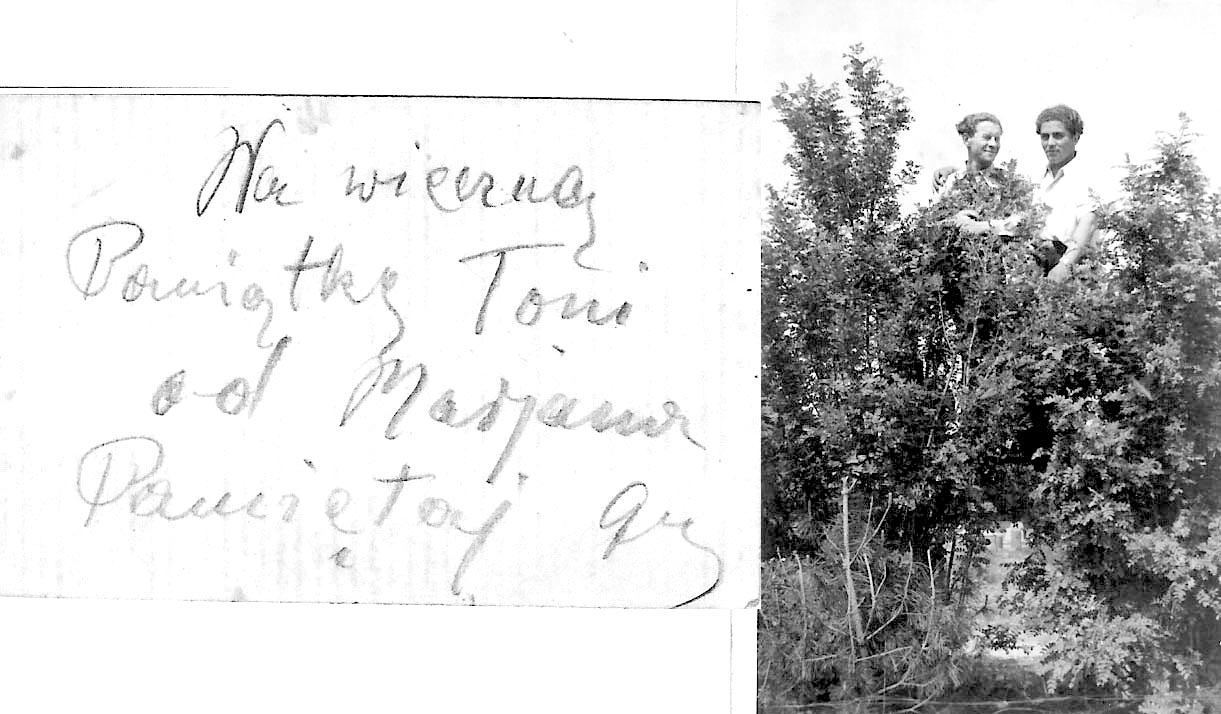
Beth Trumpeldor - Gnigl, Areal Schillinghofstrasse; Salzburg; US zone;
Bezirke district includes: Innsbruck, Kufstein, Landeck, Schwaz, Reutte, Imst Kitzbühel
Bindermichl
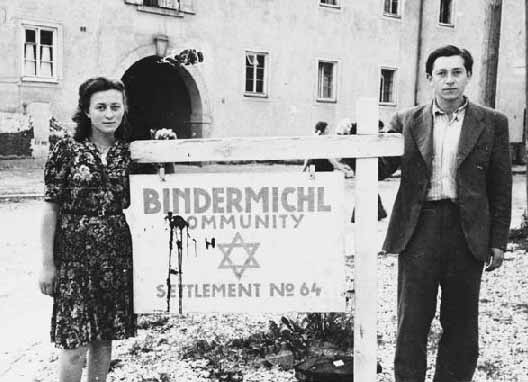
.jpg)
Linz Bindermichl camp entrance 1947; Linz Bindermichl barracks 1951;
Photo supplied by Klaus
Fohringer Austria
(Photo credits Bindermichl web pages, USHMM
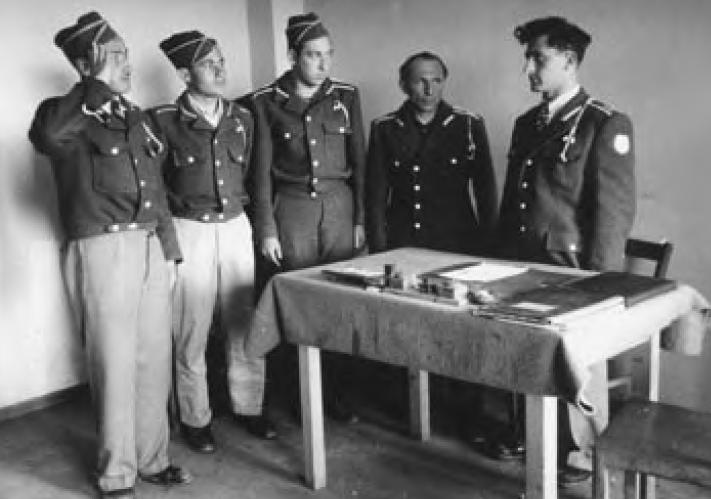
Linz Bindermichl DP police force
.jpg)
Photo supplied by Klaus Fohringer Austria
TRACING THE WHEREABOUTS OF MY SISTER:Eva (Java) SOMOGYI, born in Szigetvar, Hungary on the 13 of July 1926. Deported with my mother to Auschwitz on the 26 of April 1944 and transfered to STUTTHOF on the 20th July 1944. Based on the International Tracing Service of the Red Cross she was first registered in DP-Camp Linz-Bindermichl, Austria on the 25th March 1946 and the last record show her, in the same camp, on the 28th January 1952. Unfortunatelly these informations came to my hands just a few days ago. I will remain profoundly grateful to the person/s who know she and/or can help me to find she or can provide any information either during or after her stay in Austria. Please kindly contact by e.mail:
etiennesomogyi@sonivision.co.cr or fax (506) 231 6531 or phone (call collect) (506) 228 2917, PO Box 620-1000, SAN JOSE, COSTA RICA.
Brandlberg - camp 536 St. Lorenz?; Mondsee od. Tiefgraben
Photo supplied by Klaus
Fohringer Austria (Photo Credit St. Gem)
Franztaler Musikanten (Leopold Schwarz und Martin Waltenspiel) in Camp Brandlberg 1946
Braunauam Inn (at Inn river), Salzburg area, 57 Ukrainians, 1 Pole, 1 Jew; US zone;
.jpg)
Photo source: Austrian Picture Archives http://www.bildarchiv.at/
Birdseye view of Braunau 1914
May 6, 2020
I am reaseaching on the DP Camp Freiberg in Flossenbürg als known as "Camp Sikorski" or just DP Camp Flossenbürg on the ground of the former concentration camp Flossenbürg. I would like to come into contact with people interested or connected to the DP camp in Flossenbürg. Before coming to Flossenbürg the 2.100 DPs stayed in camps in Austria, mainly in Braunau, Ebensee, Ems, Frankenmarkt, Ranshofen, Wegscheid and Wels-Lichtenegg. Therefore I am happy to share information with researches on this camps, too. Furthermore there was a Jewish DP-Community in Tirschenreuth. As I'd like to focus on the relationship between (mostly) Polish DPs in Flossenbürg und surrounding Jewish DPs, I'd like to get to know more about Tirschenreuth, too.
SarahGrandke@gmx.de
Braunau-Laab Ranshofen - 600; 601; 602; 608; 609- Ranshofen; US zone;
Bråustübl - Salzburg; also Berufsschule; US Zone;
Bregenz (at Lake Bodensee) French Zone; camps:
Bregenz (at the capitall)
Vorkloster Weidach (city
quarter) dp camp;
Mehrerau
Bridge - Bez. Judenburg; British zone
Bruck an der Mur - British zone; Feldgasse 2
Brunnhaus barracks - Niklasdorf; British zone; 2 camps: Papierfabrik and Mur
Buch bein [near] Jenbach, camps: Schwarz, St. Margarethen, Oradour, on Inn river; French zone;
Buerglut Old People's Home, Land Upper Austria, US Zone; see Sankt Wolfgang am Wolfgangsee
Burgenland - (Swiss zone)
Carinthia - see Kårnten - Carinthia seems to be the British translation for Kårnten
BOOK: Refugee Need and Refugee Aid in Carinthia after 1945 (Steiber, 1999; ISBN 3-900531-46-3) English version
Caritas-Heim - Wien
Conrad v. Hotzendorfstrasse Nr.99; VI., Jakomini, Graz, British zone; urspr. Baubaracken
Lots more information on Austria D-G
18.1.2023: Hello,
My name is Franziska Lamp and for my dissertation project at the University of Vienna, which is looking at migration policies in Austria after the Second World War (https://displacement-and-migration-regimes.univie.ac.at/), I am conducting narrative, oral history interviews on the life stories of former Displaced Persons (DPs) and refugees who spent parts of their lives in Austrian DP / refugee-camps after the end of World War II. If you have any information about experiences and memories of life in these camps or would like to give me an interview, please feel free to contact me under the following email:
franziska.lamp@univie.ac.at
Department of Contemporary History
University of Vienna
Spitalgasse 2-4, Hof 1
1090 Vienna
https://zeitgeschichte.univie.ac.at
Kind regards and thank you so much again for your help and for creating this great website!
Franziska Maria Lamp, BA BA MA
Wissenschaftliche Projektmitarbeiterin & Doktorandin/ PhD-Researcher
Institut für Zeitgeschichte/Department of Contemporary History
Universität Wien /University of Vienna
Spitalgasse 2-4, Hof 1
1090 Wien / Vienna
franziska.lamp@univie.ac.at
+43-1-4277-41219
https://zeitgeschichte.univie.ac.at
Project homepage: https://displacement-and-migration-regimes.univie.ac.at/
Recent Publications:
"The `unmarried mother': Single-mother families in displaced persons camps
in post-World War II Austria, in: Routed, Migration & (Im)mobility Magazine,
https://www.routedmagazine.com/unmarried-mother-wwii
"…ob er mit seiner Eheschließung der Volksgemeinschaft nützt,'“ in:
Junges Forschungsnetzwerk Frauen- und Geschlechtergeschichte,