Demjanjuk, convicted without proof on May 12, 2011 of 28,000 counts of being an accessory to murder and sentenced to five years in prison, died a free man in a nursing home in the southern Bavarian town of Bad Feilnbach. He had been released pending his appeal. The German Jews broke all the legal rules to prosecute Demjanjuk.
PRESS RELEASE March 19, 2012 Dr.
Ulrich Busch, Attorney for late John Demjanjuk
What the media reports to the German and international
public about the death of my client John Demjanjuk contradicts
the objective truth and is in all respects misleading, tarnishing
the memory of my client.
He is almost exclusively depicted as a convicted
war and Nazi criminal, who has driven 28,000 Jews into the gas
chambers of Sobibor.
It is a fact, however, that my client has died unconvicted and a free man. The verdict of the District Court in Munich is void and this trial has failed. The Supreme Court can no longer clarify the question of guilt. The trial will be dismissed, probably with specific lifting of the verdict of the Munich District Court. It is a fact, that the media knows, who the true murderers of Sobibor are, namely the Germans.
It is not understandable why the media keeps silent about them and their non conviction. Another fact is that there is no reference to the gruesome killing of 3.5 million Eastern European Prisoners of War by Nazi Germany.
Dr. Ulrich Busch - Defense attorney for Demjanjuk
Nigel Jackson: Inconvenient
History | A Quarterly Journal for Free Historical Inquiry
For full story,
down load pdf file here: Inconvenient History
The death
of John Demjanjuk brings to a close one of the most
repulsive and inhumane persecutions of a human being in European
history.
Yoram Sheftel, Demjanjuk’s
Jewish lawyer, provided in his 1995 book Show
Trial a thorough exposure of the massive corruption involved
in the staging of the first Israeli trial of Demjanjuk, whose verdict
had to be overturned in the appeal trial because of irrefutable evidence
found after the collapse of the Berlin Wall.
There is plenty of evidence, too, that corruption was involved
in the further campaign against Demjanjuk, which resulted in his cruel
deportation to Germany in his late eighties. As for the charges on
which he was then found guilty, they are thoroughly preposterous.
Moreover, revisionist historians have mounted a strong case
that Sobibor was not, in fact, a death camp at all, but a transit
camp. The continuing
persecution of these historians in more than a dozen countries merely
adds to the conviction that there is something very rotten indeed
in contemporary Western European political orders.
As for the identification card placing Ivan Demjanjuk at Trawniki, which the Soviets conveniently produced in 1980, Buchanan provided the following critique:
- An expert who examined the card found that an “umlaut” was missing on a word on the ID card and that the card used, instead of a separate letter, a combination of letters not common in German until about 1960.
- The former paymaster at Trawniki claims he never saw a card similar to this one at the camp: “Missing is the date of issue, missing is the place of issue, missing is the officer’s signature.”
- The photograph
of Demjanjuk on the card has been tampered with – parts
are blocked out. Demjanjuk – from
a blow-up – is wearing a
Russian
tunic.
- The photograph was obviously stapled
to some other document before being
placed on the card.
- The seals
on the card are misaligned – as though separate
documents were placed together.
- The card gives
Demjanjuk’s height as roughly 5ft 9in – he
is actually
6ft 1in.
- We have no card; the Soviets have only provided a photostat copy.
http://www.inconvenienthistory.com
March 21, 2012 Statement
from his son: John Demjanjuk Jr.
My father died a free man, innocent and not
convicted since a successful appeal could not conclude
upon his death. Over the last 35
years, the only criminal proceeding that did conclude
resulted in an Israeli acquittal.
Since the accusations in Germany, I stated that it was a political farce as at his advanced age and poor health he could not survive another legal process. As Nazi Germany committed crimes against humanity by killing a forgotten several million Soviet POW's by a tortuous starvation and diseased death, today's Germany intentionally chose such a surviving POW as a scapegoat to blame Ukrainians for the Nazi crimes by German criminals which historically went unpunished.
John Demjanjuk, as a child, survived Stalin's murderous forced famine
in Ukraine. Having fought the Nazis as a young drafted Red
Army soldier, he survived when millions like him died. From
childhood to elderly death, he suffered while surviving unfair battles
in Europe, the US, Israel and finally and inexplicably in Germany. He
will be buried a survivor of Soviet and German persecution, an innocent
and free man who loved life and whose path was not guided by his
free will but by the strength God provided him to survive his journey
home.
John Demjanjuk Jr.
March 22, 2012 Stephen Paskey:
To Demjanjuk’s family and supporters, the case represented an abuse of government power and a waste of government resources. And for many Ukrainians, the case involved a kind of “ethnic profiling.” There is a sense that Demjanjuk was a convenient scapegoat, that his role in the Holocaust did not justify a prosecution, and that someone who was not Ukrainian would have been treated differently.
All of this is a matter of ethics or opinion rather than fact. Neither side is entirely right or entirely wrong, and sometimes the lines are blurred. In the course of my work, I interviewed dozens of Holocaust survivors. A small but striking percentage told me that the prosecution of Nazi guards was pointless, that nothing could be gained from pursuing such men so many years after the fact.
Why, then, did the Germans choose to prosecute Demjanjuk at the last possible moment? And why a Ukrainian rather than a German citizen? Given Germany’s long history of neglect in similar cases, the criminal case against Demjanjuk was unjust and should not have gone forward.
From 1995 to 2007, Stephen Paskey served as a trial attorney with the
United States Department of Justice. He currently teaches legal analysis,
writing, and research at the SUNY Buffalo Law School in Buffalo, New
York. The opinions expressed in this article are entirely his own.
http://www.kyivpost.com
Demjanjuk's life story condensed:
http://www.esquire.com
http://www.foxnews.com
A French Jew lawyer who wanted to make a name for himself (which will be called ScumBag from here on) sued Demjanuk for the deaths of 28,000 Jews, with absolutely no proof. (According to ThirdCraft website, ScumBag is a convicted drug user, pedofile, abused hundreds of Ukrainian women that had been druggged, raped and forced into prostitution. http://www.thethirdcraft.org/
"In January 2011, a Spanish judge indicted Demjanjuk on charges of being an accessory to genocide and Crimes against Humanity, based on the accusation that he was a guard at the Flossenbürg concentration camp in Germany. The Spanish are expected to have Demjanjuk extradited to Spain when the German trial ends."
"Demjanjuk’s trial ...
conducted in Germany where judges takes judicial notice that
Jews were killed in gas chambers by the Nazis, so no
proof is required. If his attorney were to ask for proof that
there were gas chambers at Sobibor, he would promptly be arrested
for being a Holocaust denier. He would have no defense
because the Holocaust is considered to be “manifestly obvious” by
the German courts and does not have to
be proved."
The big farce.
Trial
Third craft.org
Third craft.org
No evidence was produced that he committed a specific crime. The court found him guilty. Sentenced to five years. Judge Alt said he had ordered Demjanjuk freed during his appeal as he did not pose a flight risk because of his advanced age, poor health and the fact that he was stateless following his expulsion from the US. http://topics.nytimes.com
The German government is forced to pay his medical treatment under duress since he is Stateless. He is not allowed to go to the US to visit his family. He has very little provisions or money. John, a Ukrainian native who survived the Famine Genocide of 1932, continues to claim he was captured by the Russians, then captured and held as Prisoner of War with the Nazis, forced for work for the Nazis to stay alive.
Feb 2012 - Diaspora and Iwan Demjanjuk, by Anthony Schlega
Something
annoys about the use of the name Diaspora, and what the Diaspora
can do or is expected to do for Ukraine. Recently I was able
to talk to someone who had just talked to the Ukr. Consulate
in Munich at our Church where I was also present, about Iwan
Demjanjuk. I was told the word is.... Iwan
is not recognized as Ukrainian so there is nothing
we can do for him. So let this be a warning to all
the Diaspora who want to do something for Ukraine. It doesn't work the other way around.
And if anyone can help here is the latest news on Iwan:
It is 9 months since the trial. The appeal was turned in immediately.
The court in Munich has NOT yet turned it over
to the highest appeal court in Karlsruhe!
Anthony Schlega writes about his friend, John Demjanjuk http://www.cossacks-lienz.net
More:
http://www.xoxol.org
http://www.xoxol.org
http://collections.yadvashem.org
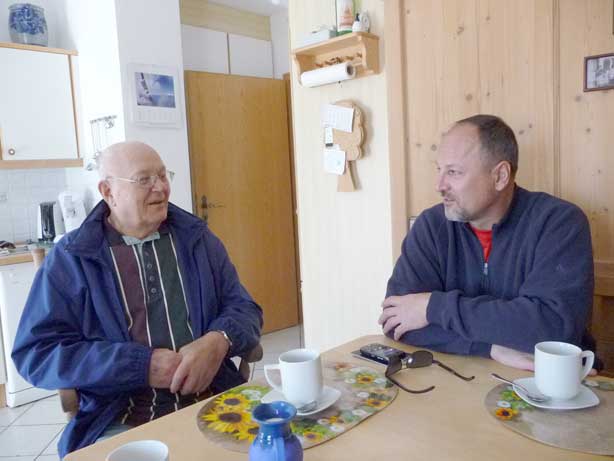
John
Demjanjuk on the left. ......Anthony Schlega on right
2011 - This
was found on E-Poshta Sept 6, 2011 issue.
http://www.eposhta.com
submitted by Slavko
/ C/\ABKO
Demjanjuk’s trial was an illegal political showcase so Germany
could minimize its guilt for the Holocaust
Speech by Dr. Ulrich Busch, John Demjanjuk’s
lawyer at Ukrainian World Congress -
Human Rights - Kyiv 20.8.11
So now in 2011 we know that:
Moscow had all the evidence, that John was not Ivan the Terrible:
The United States had all the evidence, that John was not Ivan the
Terrible:
Israel had all the evidence, that John was Anthony Schlega Ivan the Terrible:
Poland had all the evidence, that John was not Ivan the Terrible.
The question is, why did Germany put John on trial. The answer is easy: The trial was an illegal political show case. Germany looked for a chance, to show the world, that not alone Germans are guilty of the Holocaust.
Ladies and Gentlemen,
My English is not very good. But I presume, that my English is still better than your good German. So I decided, not to torture you with my good German, but to bother you with my bad English.You are lucky, that I do not try my Ukrainian. It would be a poor speech:
Shcho, Shcho? Ya ne rosomiyu. Djakuyu. Do pobachynja.
Thank you very much for your inivitation and the opportunity, to talk
about John Demjanjuk and the trial against him in Munich, Germany.
The trial has a very long history of 35 years of legal struggles against unfair and made up accusations, false and faked evidence, lying witnesses and corrupt prosecutors and judges. The fight began in 1976 and is still not finished in 2011, the year, John had to celebrate his 91 birthday in a cell in the Munich prison, where the mass murderer Hitler was sitting in the 1920ies.
Not only these 35 years were terrible for John; his whole life is a
human tragedy, a nightmare.
Holodomor, World War II, Red Army soldier, serious war injuries, POW
in a Nazi POW camp, loss of US citizenship, extradition to Israel,
death sentence in Jerusalem, seven and a half years in prison, 5 years
in a death cell, deportation to Germany, trial in Germany, two years
in a German prison.
Each of these events means massive illegal and inhuman treatment. For example: John was 12, when he was starving from a hunger, created by the Stalin artificial food shortage in Ukraine through the time of Holodomor, 1932-33.
About 8 million Ukrainians died from starvation, killed by the mass murderer Stalin. As a child, John experienced the cruelty of the misuse of state and police power, living in fear of his life and between mountains of dead bodies around him.
Or: In the German POW camps for Red Army soldiers 3.5 million men out of 5.3 million died from starvation, cannibalism and epidemics. More than a million victims were Ukrainians. The POW camps were nothing else than death camps, the Red Army soldiers were criminals in the eyes of the SS and "Wehrmacht", the Germany Army.
The latest inhuman treatment was John's deportation to Germany and the trial in Munich.
Deportation was chosen by the United States and Germany to avoid the principle of double jeopardy. An extradition, the legal way, was forbidden by Israeli, German and American law. Only the illegal deportation under the avoidance of extradition opened the possibility to reopen the Israeli trial and to overrule the decision of the Supreme Court of Israel, to aquit John from all charges and to dismiss the case concerning Sobibor.
The deportation itself was already the conviction in Germany: John has to stay in Germany until death under complete isolation and welfare conditions. He has no right to and no way of returning to his wife and children. For John there is no difference between a room in a nursing home and a prison cell. The deportation destroyed his life completely. John's legal situation after the deportation was already punishment for life, before the trial started or ended. Punished, if guilty or not.
Germany against John Demjanjuk: an unfair and inhuman trial of the German Government against an innocent man in his nineties.
Why? Let's go to Moscow, back in 1979.
It was the KGB, who offered copies of so called evidence, which was
produced in secret trials and under torture of their victims. The "Dienstausweis
Nr. 1393", (service card), was declared a fake of the KGB by the world's
most famous expert, Dr. Grant. The German head office for criminal research, "Bundeskriminalamt",
estimated the service card as a very simple falsification
of the KGB. We all know, that the Soviet law and court
system and all the KGB activities were never intended
to achieve justice, they only served and supported the
ruling dictator and mass murderer Stalin and his successors.
The prosecutors and courts were political instruments,
used to liquidate opponents and the freedom of people
in the subjugated satellite states like Ukraine.
Let's go to Jerusalem, back in 1986 - 1993.
What do you think is the most remarkable event in the Israel trial
against John Demjanjuk? I am sure, you will all say the acquittal of
John by the Supreme Court from being Ivan the Terrible. What a great
court! Excellent judges!
For me the most remarkable event in Israel was the death sentence of the District Court against an innocent man. This result clearly shows evidence of the weakness, of the mistakes and errors of human court systems and their judges.I contradict: For me the most remarkable event in Israel was the death sentence of the District Court against an innocent man. This result clearly shows evidence of the weakness, of the mistakes and errors of human court systems and their judges. The judges in Israel wanted to believe in the guilt of John as Ivan the Terrible. The world's mass media hysterically asked for a death sentence and there was only John, his son, his son in law and his lawyer, Sheftel, who believed in John's innocence. And there were these criminal and corrupt prosecutors, who fraudulently misled the American and Israeli courts. The Office of Special Investigation (OSI) from the US Department of Justice and the Israeli prosecutor withheld existing evidence, that John was not Ivan the Terrible. They wanted the death sentence against a man, from whom they definitely knew, the he was innocent and not Ivan Grosny.
And it worked. They got, what they strictly wanted, the death sentence, by withholding the so called Danilchenko Statements. Ignat Danilchenko was a Trawniki, who was forced by the Nazis to be a guard in Sobibor. After the war he was repatriated to the Soviet Union and convicted as a traitor of his Motherland to 25 years in the Gulag. [He admitted that he was tortured by USSR.]
After the manipulation was discovered, after it was established, that there was more material in the archives of the Russian KGB, the defense was able to find 36 statements of Treblinka guards, that Ivan Marschenko and not John Demjanjuk, was Ivan Grosny. The discovery of the manipulation was the reason for finding so much exculpatory material in the Moscow archive, that John had to be acquitted from being Ivan the Terrible. But for 5 years there had been only an inch between John and the gallows.
At first I did not believe, what I had read in a memo of the well known Polish historian Jacek Wilczur, adressed to the director of the Main Commisssion for Nazi Crimes in Poland, Prof. Dr. Kakol, dated April 21, 1987.
"On the 27. of March of this year (1987) I met Janusz Kobus from Rembertow by Warsaw. Kobus knew the SS guard team of Treblinka II very well. Among others, also Ivan the Terrible, with whom he drank Vodka and who once showed him - almost at the end of 1942 or beginning of 1943 - in a drunken condition, his SS Army card. Kobus states that he saw and could read the name Marczenko and the birth place, Dniepropietrowsk. Ivan the Terrible was supposed to have personally said to Kobus that his name is Marczenko. Kobus says that this Marczenko - Ivan the Terrible - was 185 cm tall with black hair and a yellowish face color. ...
Kobus was sure that the photo of Ivan Demjanjuk, which I showed him and on which John Demjanjuk is shown in the court room in Jerusalem, does not show Ivan the Terrible.
In a telephone conversation on the 5. of April 1987 the prosecutor Michael Horovitz of the Israel General Prosecution explained to me that all the information which I received from Janusz Kobus ... could complicate the situation of the Israel prosecution (in the case against John Demjanjuk) and urgently asked me not to officially transfer this information to the prosecution or to disperse it in any other way. I obliged to follow this demand of the Israel prosecution."
This memo was hidden in a volume of 1,000 pages of Polish papers
and it was pure luck, that I found it. Four countries, four governments,
that knew the truth about John, that knew, that he was innocent, kept
silent, when John was sentenced to death, they hid the evidence of John's
innocence.So now in 2011 we know that:
-
• Moscow had all the evidence, that John was not Ivan the Terrible:
• The United States had all the evidence, that John was not Ivan the Terrible:
• Israel had all the evidence, that John was not Ivan the Terrible:
• Poland had all the evidence, that John was not Ivan the Terrible.
Four countries, four governments, that knew the truth about John, that
knew, that he was innocent, kept silent, when John was sentenced
to death, they hid the evidence of John's innocence.
Now let's go to Munich.
In the first instance the trial lasted 93 days, beginning
on Nov. 30. 2009 and ending on the 12. of May 2011. John
was very ill the whole time, he suffered from gout, pre
cancer, major back pain, heart and kidney problems and anxiety among
others. In two years of imprisonment John was not living
outside of the jail hospital or without pain. The Munich court delivered a political show trial, in which
almost every human right of the European Convention was violated. The atmosphere in
the court was full of pure hate against John and the defence. From the
beginning John was a Nazi monster, a mass-murderer, the Ukrainian Hitler
and Eichmann for the German media. The Simon Wiesenthal Center had placed
John on top place of the most wanted Nazi criminals.
Some examples:
• Since John was never a German citizen, since Sobibor
is in Poland (not on German territory),
• Since the Jews, who were
killed there, came from Holland and were not German citizens, Germany
never had jurisdiction in the case.
After the UN Resolution 3074 and International Law only Poland had jurisdiction in this case. Poland used this power of jurisdiction and started a case against John. With the decision of December 2007 the Polish prosecutors dropped the case with the final statement, that there is no existing evidence, that John committed any crime in Sobibor.
The German court had to respect this Polish decision according to Rule 54 of the Schengen Treaty. It ignored its duty.The Ludwigsburg Special Forces for the Persecution of Nazi Crimes already found out in 2003, that there is no evidence, that John ever committed a crime during Nazi time and during his time as a POW.
The court in Munich kept silent, although knowing the result of the Ludwigsburg investigation.
Germany aquitted many of the Nazis or did not prosecute them. One of the high ranking Nazis, the SS "Hauptsturmführer" Streibel, who was the leader of all Trawnikis, who were sent by him to the three death camps, Belzec, Sobibor and Treblinka, was aquitted by the Landgericht in Hamburg. With this decision Germany lost the right, to prosecute the simple Trawnikis, who Professor Christiaan F. Rüter from the Amsterdam University called the smallest of the small fish.
Germany changed its whole traditional jurisdiction for a conviction of John. For 70 years it was agreed by all German prosecutors, courts and the government, that those helpers of the Nazis, who had no power of command, should not be prosecuted. Around 100.000 German helpers met these conditions and were granted amnesty. The only one, who did not get this amnesty, was the foreigner, John Demjanjuk.
For 70 years it was a main principle of German law that being present at a death camp, does not lead to a conviction of being an accessory to murder. This very important rule was changed only for John Demjanjuk and nobody else, by the Munich court.
It would take hours to give you a full review of all the violations of the law and human rights of John in Munich. The court gave him a sentence of 5 years in prison, knowing, that John already served more than seven and a half years in Israel for Treblinka and Sobibor. Another fulminant violation of German law, because the court had to deduct the years in prison in Israel from the German 5 years.
I appealed the sentence on the same day John was convicted. The legal consequence is the suspension of the sentence, until the Supreme Court of Germany will decide about the appeal, which will happen approximately in 2012.
But at least, the court followed my demand to release John from jail. John is now a free man. The release from jail was a most important goal, the defence wanted to reach.
The release shows, that the Munich court is afraid, that its judgment will be lifted by the Supreme Court and that John will be acquitted from all charges by the "Bundesgerichtshof" in Karlsruhe.
The question is, why did Germany put John on trial. The answer is easy: The trial was an illegal political show case. Germany looked for a chance, to show the world, that not alone Germans are guilty of the Holocaust.
They wanted to send the message to the world, that without the help of 100,000 foreign helpers the Holocaust would have never happened. John Demjanjuk, a born Ukrainian, allegedly a member of the 5,000 Trawniki, who allegedly were all Ukrainians, was at the right time the scapegoat, to demonstrate, that Ukraine is as much responsible for the Holocaust as Germany, or even more responsible than Germany, because the sentence of 5 years against a 91 years old man for assumed crimes in 1943, more than 70 years back, is much stronger and brutal than the sentences against high ranking Nazi murderers in Germany in the last 70 years.
It will be the duty of the Ukrainian nation and the World
Congress of Ukrainians, to watch the further development in the
case against John and to take care, that Germany will not be
released from its full responsibility for the Nazi crimes.
Dr. Ulrich Busch
May 16, 2011 DEMJANJUK: DREYFUS IN REVERSE
By Askold S. Lozynskyj (New York City Attorney at Law and former president of the Ukrainian World Congress)
Holocaust survivors are living longer than expected. Reparations being paid by Germany have proven inadequate to compensate. Israel requested more money. Germany sought alternative sources. A theory was advance that Nazi Germany could not have accomplished “the final solution” without the assistance of non-Germans. The Demjanjuk case, although deeply flawed, was the most prominent unresolved case involving the Holocaust. The United States having denaturalized Demjanjuk for a second time, hastened to find him deportable. Germany agreed to the charade, but did not request extradition as that would have necessitated a thorough investigation as to what Germany was planning to do and upon what grounds. Germany issued a warrant despite an incomplete investigative file and the United States simply deported Demjanjuk to Germany. Finally, in essentially a show trial, the German judicial system relinquished any pretense at propriety and independence. It simply carried out the German government’s political agenda.
John Demjanjuk never had a chance in Germany. He was accused of almost 28,000 counts of accessory to murder. True he wasn’t directly responsible for any death. There wasn’t even an allegation of personal involvement of abuse. His alleged crime was being at Sobibor, a killing camp. Except that no witness from Sobibor could identify him. So an old piece of Soviet compromised evidence was drudged up. Even the FBI acknowledged that it was likely a forgery. Nonetheless, the show had to go on and the court had to convict. Otherwise, the entire political exercise would have been exposed as a sham. And so the German court convicted, then sentenced a 91 year old Ukrainian America, formed Red Army POW on almost 28,000 counts of accessory to murder.
In the 1890’s and early 1900’s another country, France conducted a similar quasi judicial sham exercise of its own concoction. The case involved the conviction for treason (ironically on behalf of Germany) of Captain Alfred Dreyfus, a French artillery officer of Jewish descent. The evidence against him was egregiously inadequate. But French societal anti-Semitism insisted upon conviction. Two years later new evidence appeared which clearly exposed another perpetrator. The latter was brought to trial, but France could not let go of anti-Semitism, so the real perpetrator was acquitted. The conviction of the Jew was affirmed despite the obvious. Finally, Dreyfus was exonerated, but only twelve years after his initial conviction and after French society’s thirst for Jewish blood had subsided.
The Demjanjuk case is Dreyfus in reverse. Dreyfus was a glaring example of injustice resulting from extreme societal anti-Semitism so severe that it affected the entire country, its political and judicial systems and even the media. Demjanjuk is an equally glaring example of injustice, resulting from just the opposite - extreme societal pressure not to appear anti-Semitic by failing to somehow honor the victims of the Holocaust through the punishment of their tormentors whether they actually did anything or not.
There is another problem, aside from the perversion of justice and the obvious inhumanity. This problem is more subtle than the irony of the perpetrator standing in judgment over his own victim. Even assuming facts not in evidence, to wit: that John Demjanjuk was ever at Sobibor, by every account he was a POW in German servitude under penalty of death. He could neither disobey nor flee. Now that Germany holds out the illusion that it has tried and convicted John Demjanjuk in a proper judicial proceeding, Germany has the duty to pursue every cog in its Nazi apparatus, willing and unwilling, every guard, every soldier and, yes, every capo. But Germany has enacted legislation precluding prosecution of any such German cog. Jewish capos should feel safe as well.
The case of John Demjanjuk is now an international conundrum. Germany most certainly should have its already bloody hands full prosecuting or explaining selective prosecution. The United States equally at fault for pandering to a fringe bloodthirsty Jewish constituency in the instant case, should be busy in its continuing role as Germany’s co-counsel. Russia is affected, since often as in the Demjanjuk case, its Soviet labs offered primary sources of fabricated evidence which served as the basis for convictions. Despite the apparent demise of the Soviet Union, Russia’s archives remain. But then Russia is immune to criticism since it neither abides by nor respects the rules of a civilized society. Israel appears quite respectable, having accused, investigated, tried and then dismissed all charges against John Demjanjuk including any Sobibor role. The only blemish is that it held John Demjanjuk on death row for five years. Perhaps that pales with his entire more than thirty year ordeal proclaiming his innocence. Seeking additional reparations for its citizens cannot be considered improper. In fact, it was obligatory upon Israel.
On the other hand there is that part of the global Jewish community which could not accept Demjanjuk’s innocence, the findings of the Israeli courts or the rule of law. Many concerned Jews disagreed, yet remained silent. But then, that’s precisely why anti-Semitism exists to this day. Today it’s being fed by extremist Jews themselves and the silence and acquiescence of others.
Askold S. Lozynsky, (212)254-2260
2011- Ukrainians back Demjanjuk, convicted and stateless
THOMAS J. SHEERAN, May
27, 2011
Excerps from Associated Press.
For full story see: http://my.earthlink.net
Demjanjuk was convicted in Munich on May 12, 2011 of 28,060 counts of accessory to murder as a guard at the Sobibor death camp. He was sentenced to five years in prison but was released to await an appeal that could take years. He's since been living in a nursing home on the German dime.
One of Demjanjuk's few options appears to be fighting to regain his U.S. citizenship based on a 1985 FBI document, uncovered in April by the AP, calling into question the authenticity of a Nazi ID card used against the Ukraine native at his trial.
The German trial and U.S. citizenship issue are separate, and the federal judge in Cleveland who might handle the citizenship matter has said Demjanjuk must serve his sentence in Germany.
Demjanjuk lost his U.S. citizenship twice before, the first time after the Justice Department alleged in 1977 that he hid his past as a Nazi death camp guard known as "Ivan the Terrible." He ultimately was convicted in Israel and sentenced to die, but the case was overturned. [Olga's comment: They'll keep going after him because they need a sacrificial lamb.]
Demjanjuk has always maintained he was a victim of the Nazis — first wounded as a Soviet soldier, then captured by the Germans and held as a prisoner of war.
"Ukraine was ravaged by the Second World War," said Askold Lozynskyj, former president of the Ukrainian World Congress. "Russia wrote our history, so as a result, we've been scapegoats for a lot."
Demjanjuk's stateless status is a rarity. An American judge has suggested that a public defender recently appointed in Cleveland to represent Demjanjuk's interests could revive his U.S. denaturalization case using the FBI report that challenged the authenticity of the ID card that was trial evidence. The file indicated the FBI believed the card, purportedly showing that Demjanjuk served as a death camp guard, was a Soviet-made fake.
2011 - The Persecution
of John Demjanjuk
By Pat Buchanan 5/13/2011
"John Demjanjuk Guilty of Nazi Death Camp Murders," ran
the headline on the BBC. The lede began
"A German court has found John Demjanjuk guilty of helping
to murder more than 28,000 Jews at a Nazi death camp in Poland."
Not until paragraph 17 does one find this jolting fact: "
No
evidence was produced that he committed a specific crime."
That is correct. No evidence was produced, no witness came forward to testify he ever saw Demjanjuk injure anyone. And the critical evidence that put Demjanjuk at Sobibor came -- from the KGB.
First was a KGB summary of an alleged interview with one Ignat Danilchenko, who claimed he was a guard at Sobibor and knew Demjanjuk. Second was the Soviet-supplied ID card from the Trawniki camp that trained guards.
There are major problems with both pieces of 'evidence'.
First, Danilchenko has been dead for a quarter of a century, no one in the West ever interviewed him, and Moscow stonewalled defense requests for access to the full Danilchenko file. His very existence raises a question.
How could a Red Army soldier who turned collaborator and Nazi camp guard survive Operation Keelhaul, which sent all Soviet POWs back to Joseph Stalin, where they were either murdered or sent to the Gulag?
As for the ID card from Trawniki, just last month there was unearthed at the National Archives in College Park, Md., a 1985 report from the Cleveland office of the FBI, which, after studying the card, concluded it was 'quite likely' a KGB forgery.
"Justice is ill-served in the prosecution of an American citizen on evidence which is not only normally inadmissible in a court of law, but based on evidence and allegations quite likely fabricated by the KGB."
This FBI report, never made public, was done just as Demjanjuk was being deported to Israel to stand trial as "Ivan the Terrible," the murderer of Treblinka. In a sensational trial covered by the world's press, Demjanjuk was convicted and sentenced to hang.
But after five years on death row, new evidence turned up when the Soviet Union collapsed and Russia opened up. That evidence wholly validated the claims of Demjanjuk's defenders.
Not only had Demjanjuk never even been at Treblinka, the Soviet files contained a photograph of the real "Ivan" -- a larger and older man.
To its eternal credit, the Israeli Supreme Court reversed the conviction, rejected a request to retry Demjanjuk as a camp guard elsewhere in Poland, freed him and sent him home to America.
Exposed as a laughing stock, and denounced for fraud by Ohio district and appellate courts, the Office of Special Investigations began crafting a new case, John Demjanjuk of Sobibor, to deport and try again the old man whose defense attorneys had made fools of them.
Thus the Sobibor story and Demjanjuk's supposed complicity in the murder of 28,000 Jews -- though, as the BBC notes, no one testified at the trial that they ever saw John Demjanjuk injure anyone.
Consider the life this tormented American has lived.
Born in Ukraine in 1920, as a boy he endured the Holodomor -- the famine imposed on his people in 1932 and 1933 by Stalin and his hated henchman Lazar Kaganovich, which resulted in the starvation and death of somewhere between 5 million and 9 million Ukrainians.
It has been called by historians the "forgotten Holocaust."
Conscripted into the Red Army, Demjanjuk was captured in the German blitzkrieg. Unlike American and British POWs, whom Germans regarded as racial equals, Ukrainians were untermensch who could be used for medical experiments.
Not only did Demjanjuk survive, he managed to evade the Allied order, under Keelhaul, for all Red Army POWs to be repatriated to Stalin, which was the Soviet dictator's demand before he would return the U.S. and British POWs his troops liberated in the march to Berlin.
In the war's aftermath, Demjanjuk married his wife Vera, who had been conscripted in the Ukraine and brought forcibly west to work in the German economy.
Thence he moved to Cleveland, became an autoworker, raised a family and practiced his Christian faith. But he made a mistake.
He sent his wife to Ukraine to tell his aged mother that he had survived the war and was living in the great United States of America.
Word got around the village. The KGB came calling. Swiftly, the payments his mother had been receiving for her war hero son were halted, and suddenly, there turned up an ID card that said John Demjanjuk had been trained at Trawniki to be a Nazi camp guard.
The KGB began feeding OSI from its "files," as OSI began a manic persecution of Demjanjuk that has lasted 30 years.
Stalin died in bed in 1953. Kaganovich died with his family around him in Moscow in 1991. And John Demjanjuk, 91, after spending five years on death row for a crime he did not commit in a place he never was, is stateless and homeless in a Germany where veterans of the SS walk free.
That is justice -- in our world.
Pat
Buchanan is a founding editor of The American Conservative magazine,
and the author of many books including State of Emergency: The Third World Invasion and Conquest of America. http://www.amazon.com/exec/obidos/ASIN/0312360037/ref=nosim/townhallco
2011 German court convicts then frees Nazi guard Demjanjuk
May 12 2011 Reuters By Christian Kraemer MUNICH (Reuters) - A German court convicted John Demjanjuk on Thursday for his role in the killing of 28,000 Jews in the Sobibor Nazi death camp, then set the 91-year-old free because of his age.
Holocaust survivors at first welcomed the Munich court's verdict that Demjanjuk, who was exonerated in another war crimes case in Israel two decades ago, was an accessory to mass murder as a guard at Sobibor camp in Poland during World War Two.
But they then expressed dismay at Judge Ralph Alt's decision to free Demjanjuk despite handing down a five-year sentence. [Olga's comment: They needed a scapegoat but Judge Alt's conscience wouldn't allow him to punish Demjanjuk anymore than they already... based on their flimsy, fradulent Soviet identity card.]
Demjanjuk showed no reaction while the judge read out his verdict. It said guards played a key role at extermination camps like Sobibor, where at least 250,000 Jews are thought to have been killed despite only 20 German SS officers being there.
"He knew from the beginning exactly what was going on in the camp," Alt said. [Olga's comment: Perhaps he knew, but Ukrainian guards had no authority and were German prisoners themselves.]
But he said that since Demjanjuk had already been imprisoned on remand for two years, more time in jail seemed inappropriate at his age. "The defendant is to be let go," he said. A court statement cited two other reasons: Demjanjuk had already spent eight years in prison in Israel and the crime was 68 years old. [Olga's comment: they needed a scapegoat and he was it.]
Demjanjuk was initially sentenced to death two decades ago in Israel for being the notorious "Ivan the Terrible" camp guard at Treblinka in Poland. The guilty verdict was overturned on appeal by Israel's supreme court in 1993 after new evidence emerged pointing to a case of mistaken identity. [Olga's comment: Also trumped up charges based on Russia's forged input.]
The Ukraine-born Demjanjuk has been in a German jail since he was extradited from the United States two years ago and his lawyers had sought his release on age and health grounds.
He attended the 18-month court proceedings in Munich -- the birthplace of Adolf Hitler's Nazi movement -- in a wheelchair, and sometimes lying down. He denied the charges but otherwise did not speak at his trial.
JUSTICE, NOT REVENGE
Stephan J. Kramer,
secretary general of the Central Council of Jews in Germany, told
Reuters that the verdict was "not revenge but the execution
of justice, even 65 years later."
Victims' groups said the main point for them was the guilty verdict and they refrained from criticizing the decision to set Demjanjuk free.
"It's inappropriate that he be freed, but I'm not going to question the German judicial system," said Elan Steinberg of the American Gathering of Holocaust Survivors and their descendents. [Olga's comment: Then, shut up, already!]
Vera Dejong, whose family were Sobibor victims, said she was "very much relieved I don't have to have all the stress every time I have to come and sit here and hear all the horrible things that happened during the war and to my family." [Olga's comment: Of course, it was horrible, but Germany let 6,500 commanders go free. Read below.]
Demjanjuk, who was once atop the Wiesenthal Center's list of most wanted Nazi war criminals, said he was drafted into the Soviet army in 1941 then taken prisoner of war by the Germans.
His son, John Demjanjuk Jr., said in an e-mail before the verdict that his father was a victim of the Nazis and of post-war Germany. "While those who refuse to accept that reality may take satisfaction from this event, nothing the Munich court can do will atone for the suffering Germany has perpetrated upon him to this day," he said.
LEGAL HURDLES
Prosecutors had faced
several hurdles in proving Demjanjuk's guilt, with no surviving witnesses
to his crimes and heavy reliance on wartime documents, namely a Nazi
ID card indicating he worked at Sobibor which experts said appeared genuine.[Olga's
comment: which was clearly a poorly executed fraud -- read below.]
Defense attorneys said was a fake made by the Soviets. Defense attorney Ulrich Busch told the court that even if Demjanjuk did become a prison guard, he did so only because as a prisoner of war he would have either been shot by the Nazis or died of starvation.
FBI Thought Demjanjuk Evidence Faked
By DAVID RISING and RANDY HERSCHAFT Associated Press
BERLIN April 12, 2011 (AP)
http://abcnews.go.com
An FBI report kept secret for 25 years said the Soviet Union "quite likely fabricated" evidence central to the prosecutionof John Demjanjuk — a revelation that could help the defense as closing arguments resume Wednesday in the retired Ohio auto worker's Nazi war crimes trial in Germany.
The newly declassified FBI field office report, obtained by The Associated Press, casts doubt on the authenticity of a Nazi ID card that is the key piece of evidence in allegations that Demjanjuk served as a guard at the Sobibor death camp in occupied Poland.
Throughout three decades of U.S. hearings, an extradition, a death sentence followed by acquittal in Israel, a deportation and now a trial in Munich, the arguments have relied heavily on the photo ID from an SS training camp that indicates Demjanjuk was sent to Sobibor. [Olga's comment: His photo was pasted over another id and careful examination showed the cut marks and thestamp circle didn't match up.]
Claims that the card and other evidence against Demjanjuk are Soviet forgeries have repeatedly been made by Demjanjuk's defense attorneys. However, the FBI report provides the first known confirmation that American investigators had similar doubts. "Justice is ill-served in the prosecution of an American citizen on evidence which is not only normally inadmissible in a court of law, but based on evidence and allegations quite likely fabricated by the KGB," the FBI's Cleveland field office said in the 1985 report, four years after the Soviets had shown U.S. investigators the card.
It was the height of the Cold War at the time, and the ID card from the Nazi's Trawniki training camp had not been as closely examined by Western experts as it has been today. Since then it has been scrutinized and validated by courts in the U.S., Israel and Germany — though experts at the current trial left room for doubt, with one conceding that a counterfeiter with the right materials could have forged the card and other documents.
The FBI agents argued that the Soviets had an interest in faking the documents as part of a campaign to smear anti-communist emigres. Those conclusions contradict the findings of another branch of the Department of Justice, the Office of Special Investigations, or OSI, which was in charge of the overall Demjanjuk probe.
A quarter-century later, Demjanjuk, now 90, is standing trial in Munich on 28,060 counts of accessory to murder, which he denies. A verdict is expected within a month.
The AP discovered the FBI report at the National Archives in College Park, Md., among case files that were declassified after the Ukrainian-born Demjanjuk was deported from the U.S. in May 2009 to face trial in Germany.
It had not previously been seen by defense attorneys in Demjanjuk's trials in Germany, Israel or the United States, and German prosecutors also were unaware of the document. It is unclear whether prosecutors in the U.S. and Israel knew about it.
John Demjanjuk claims that he was a POW in the German Rowno and Chelm POW camps for Soviet soldiers from May 1942 until 1944. But, he has made many other claims: On April 21, 2009, The Australian (newspaper) reported that Demjanjuk registered in 1948 as a displaced person. This category was reserved mainly for former concentration camp prisoners and forced laborers. The International Tracing Service, a German agency that maintains data on Nazi victims, provided a copy of Demjanjuk's March 3, 1948, application to The Australian.
In that application, Demjanjuk
claimed to be a refugee, sought assistance, and asked for transfer to
Argentina. His application
stated that he worked as a driver at the Sobibor concentration camp;it
did not mention any work as a guard at that camp.
[Olga's comment: They produced this application but kept the FBI report hidden. Convenient.]
According to Gitta Sereny's The German Trauma (2000, ISBN 978-0-140-29263-3) there was a strong reason why Demjanjuk could have put down Sobibor extermination camp as the place where he worked from 1937 to 1943 as a farmhand (according to Sereny) in the application he made on March 3, 1948. Applicants for displaced person status had to fill in a form that required them to say where they had been for the previous twelve years. Unless they could show that they had been living outside the Soviet Union on September 1, 1939, they could not, under the terms of the Yalta agreement, be accepted as displaced persons and would be returned to the Soviet Union. Officials of the International Refugee Organisation, which operated the Landshut office, therefore encouraged applicants to select places outside the Soviet Union. Sobibor was such a place. Sereny further relates that at Demjanjuk's trial in Israel on the Treblinka charges, Judge Dov Levin had asked Demjanjuk, "Why did you put Sobibor?" Demjanjuk had replied that he had no idea what to put on the form and that another applicant had had an atlas and told him to put down Sobibor as there had been many Soviets there.
Evidence that Demjanjuk might have been at Sobibor rather than Treblinka contributed to his successful appeal against his conviction in Israel on the Treblinka charges. He was not prosecuted in Israel on any charges relating to Sobibor as, inter alia, his extradition from the USA had been obtained on the basis of the Treblinka charges.
An August 11, 2010
Esquire magazine article written and researched by Scott Raab questioned
the whole idea of Demjanjuk's trial, crime, and punishment, pointing
out many of the absurdities of this particular case, stating specifically "Worse,
Demjanjuk is essentially on trial not for anything he did, but simply for
being at Sobibor. No
specific criminal acts need be alleged, much less proved. Page through
transcripts of previous Nazi trials and you'll find a rigorous focus
on particulars, because that is what should be required to convict
a defendant. No one in any such trial ever was convicted simply
on the basis of being present at the scene."
[71]
http://en.wikipedia.org
2009 in
Kyiv Post: Demjanjuk saga enters final
round
by Andriy J. Semotiuk
With shoddy evidence, a show trial in Germany is not likely to bring justice to this native of Ukraine. As the curtain rises on the trial of John Demjanjuk on Nov. 30 in Munich, Germany, he is accused of being an accessory to the murder of 29,700 inmates of the Nazi Sobibor concentration camp during World War II.
The efforts to prosecute Demjanjuk over the last 30 years, the charges and the evidence expected to be presented all point to a show trial in the making. The rule of law is not likely to prevail. Media coverage has, so far, neglected to highlight that – in every criminal trial, including Demjanjuk’s – the basic presumption of innocence applies. The accused is presumed innocent until proven guilty. Demjanjuk does not have to prove his innocence. The prosecution must prove his guilt beyond a reasonable doubt.
Calling him a Nazi may garner headlines, but it will not change the fact that Nazi ideology precluded non-Aryans like Demjanjuk, who was Ukrainian and, therefore, an Untermensch or subhuman. This made him ineligible to be part of the Nazi Party. As an Untermensch, it is more likely Demjanjuk was a victim of the Nazi regime than a persecutor.
Background
Demjanjuk was born in Soviet-occupied Ukraine in 1920. As a child, Demjanjuk
lived through the 1932-1933 Holodomor inflicted on Ukraine by Josef
Stalin, killing millions of Ukrainians by starvation. Having survived
such a Soviet atrocity, it is not surprising that – with the outbreak of World War
II – Demjanjuk was not exactly eager to join the Soviet Red
Army. Nonetheless, he was conscripted.
In 1942, he was captured by the Germans. According to him, he languished during his wartime years as a German prisoner of war until 1945. After the war, Demjanjuk and others like him from Soviet Ukraine became the target of Operation Keelhaul. Arising out of an agreement reached in Yalta among Stalin, Roosevelt and Churchill, Operation Keelhaul enabled Soviet Red Army officers, initially acting with Allied military support, to comb through displaced persons camps looking for anyone who could reveal the truth about the abhorrent Stalinist past.
Out of those caught and destined for Soviet repatriation, some committed suicide, some were shot trying to escape and still others ended up in the Soviet Gulag. The fate of Aleksandr Solzhenitsyn comes to mind in this context. Anyone who refused to return, or who managed to evade Soviet capture, was accused by the Soviets of Nazi collaboration - whether the allegation was true or false.
Forcible repatriation became the terror of most displaced persons from the Soviet Union, including Demjanjuk. It was ironic, since the Soviets actually collaborated with the Nazis. They signed the Molotov-Ribbentrop non-aggression pact on the eve of World War II, carving up Poland with the Germans, their allies during the first two years of the war. Nonetheless, such accusations leveled against displaced persons hindered those who were unjustly accused in their efforts to emigrate to the West, at least until the Allies finally caught on to this Soviet intrigue.
In this context, in 1952, Demjanjuk obtained permission to emigrate to the United States with his wife and daughter. He settled in Cleveland, Ohio, where he found work as a mechanic at a Ford auto plant. He then had another daughter and a son. More than 20 years passed.
Accusations arise
According to recent stories, Michael Hanusiak, editor of the New York-based
Ukrainian Daily News, in 1975 compiled a list of Ukrainians suspected
of collaborating with Germans and presented it to the U.S. Immigration
and Naturalization Service.
Demjanjuk was on the list. What Engelhart failed to identify was that the Ukrainian Daily News was nothing more than a Soviet mouthpiece, at least according to Yoram Sheftel, an Israeli attorney who wrote about the incident in his book Defending Ivan the Terrible. The newspaper served as a convenient vehicle for the Soviet KGB to set off Ukrainians against Jews, particularly in the United States.
In 1977, Demjanjuk was accused of being Ivan the Terrible, a gas chamber operator in Tremblinka death camp in Poland. From 1977 to 1993, Demjanjuk faced a long series of court hearings through the American and then Israeli court systems. The case went all the way to the Supreme Court of Israel.
In the course of those hearings, he was found guilty and sentenced to death. In short, for 15 years, as he sat in U.S. and Israeli jails, those who pursued and prosecuted Demjanjuk were positive that he was not in Sobibor as they claim now, but rather in Tremblinka.
But in 1993, after the defense was able to amass irrefutable evidence to the contrary, the Israeli Supreme Court lifted the sentence, dismissed the charges which, incidentally, included that he was in Sobibor, and allowed him to return to the United States. In the meantime, a U.S. federal appeals court had opened up his case after determining that U.S. prosecutors were guilty of prosecutorial misconduct in failing to earlier reveal to the defense certain exculpatory evidence they had in their files. Demjanjuk’s U.S. citizenship was reinstated and he was allowed to go free once again.
As it turned out, Demjanjuk was definitely not Ivan the Terrible of Tremblinka. But those who had pursued Demjanjuk for 15 years, swearing for certain he was in Tremblinka and not anywhere else, then declared – no, he was not in Tremblinka, but rather he was in Sobibor! The process started all over again in 2002. And this year, Demjanjuk was once again on an airplane headed out of the country, this time to Germany. That brings us to now.
The German case
The question arises: Why has Germany decided to target Demjanjuk?
And why now, after 30 years of silence, while the Demjanjuk case made
its way through the U.S. and Israeli courts? After all, there was
no shortage of Nazis to prosecute – no shortage of party members,
Nazi government officials, army officers and camp commandants.
Why, for example,didn’t Germany prosecute Reinhard Gehlen, the former Nazi chief of the eastern front intelligence and the other ex-Nazis he gathered in the West German Federal Intelligence Service (BND) that he headed after the war, according to the Engelhart article?
The answer is that Germany did not have the stomach to prosecute its own transgressors. While modern-day Germany has paid dearly to disassociate itself from its Nazi past, paying out millions of dollars in reparations to Nazi victims, running effective educational, restorative and commemorative programs, it is also true that Germany’s pursuit and conviction of its own Nazi transgressors has been not as impressive. Though German courts investigated more than 100,000 cases, only some 6,500 accused were convicted and, of these, most received light sentences.
Not long ago Germany passed legislation that effectively provided amnesty from prosecution for German Nazis, including SS concentration camp commanders and their German subordinates. But the amnesty did not include Untermenschen like Demjanjuk.
That fact alone makes it hard to believe that this case is not a show trial. Consider the charge itself. Demjanjuk is charged not with war crimes or crimes against humanity, nor even of murder, but of being an accessory to murder. Not murder in Germany, but in Sobibor, that is to say, in Poland. Not as a high-level official, but as a low-ranking guard. Not as a German, but as a Ukrainian. Not of one or a few victims - but of 29,700 victims! Adolf Hitler in his 1925 autobiography Mein Kampf of a lie so “colossal” that no one would believe that someone “could have the impudence to distort the truth so infamously.” It seems almost as if this is the approach being used by the prosecutors in Munich and that German descendants appear ready to buy it once again today.
Two key issues
For 30 years, Demjanjuk has maintained his innocence. Yet now, the
German prosecutors who say that he was present in Sobibor will use
a Travniki identity card to attempt to prove this claim and will argue
that he was a volunteer there. While it is impossible in the context
of an article like this to thoroughly deal with these charges, nonetheless
they deserve at least some comment.
In the book Defending Ivan the Terrible, Yoram Sheftel, the Israeli defense attorney in the successful Demjanjuk appeal, points out that -- from the very beginning -- American authorities with the help of Israeli police prepared “photo spreads” to be presented to Sobibor survivors in which Demjanjuk’s picture was included for identification.
Sheftel indicates that “all 10 Sobibor survivors in Israel, who were shown the photographs, recognized neither Demjanjuk nor Federenko as someone from the Sobibor death camp. Thus, at that early stage, it was clear that the Soviet plot to present Demjanjuk as a former guard at the Sobibor death camp was totally unfounded.”
So far as is known there is no witness who can establish that Demjanjuk even harmed someone, much less murdered anyone. Only one statement taken by the Soviet KGB secret police of a Sobibor guard named Danylchenko indicated that Demjanjuk was also there. Danylchenko later indicated he was tortured by the KGB and has since died without ever being cross-examined. That is the extent of the known German prosecution evidence on presence.
With regard to the Travniki card, Sheftel indicates that on Jan. 23, 1987, the original Travniki document that purports to indicate that Demjanjuk was in Sobibor was provided for examination to the German police force’s main criminal-identification laboratory in Weisbaden, known as BKA. The laboratory analysts indicated that even after a cursory examination, it was evident that the document was a forgery. They pointed out that the face in the photograph which the prosecution in Israel had identified as Demjanjuk’s had been posted on to the uniform using photo-montage techniques.
The picture was not originally attached to the card, but had been transferred from another document. There was no match between the seal on the Travniki picture and that on the document itself. Further German analysis was stopped by the Israelis with this initial report.
The Travniki document was also the subject matter of the evidence of Julius Grant, the world’s foremost forensic expert and the man who revealed the forgeries of the “Mussolini diaries” and the “Hitler diaries.”
Having analyzed all the known signatures of Demjanjuk in the years 1947 to 1986, Grant testified that the Demjanjuk signature on the card differed from all the others in the way the Ds and Ms were formed and in the fact that in all other signatures the writing was continuous but on the card it was not. Further, Grant pointed out that there were two holes in the right side of the picture on the card whilst on the paper under the holes in the photograph there were no holes. Judging by the purple ink found inside the holes which was similar to ink used by the KGB and the nature of the spacing of the holes, Grant concluded it was more logical to assume that the photograph was unstapled from some other Soviet documents and attached to the card in the Soviet Union, than that it was attached in Travniki in 1942.
Israeli officials refused to allow Grant to detach the photo from the card to make a conclusive finding, but he nonetheless concluded his evidence by saying that “the Travniki document cannot be an authentic document belonging to the defendant Demjanjuk.”
As for the contention that non-German guards in Nazi concentration camps were volunteers, the evidence indicates that basically such Wachmaener were chosen by the Germans based on physical fitness and told they could either become camp guards or remain in prisoner of war camps where they were mistreated or died. Those who tried to escape were shot. What choice is there in these alternatives? This assumes that the prosecution can establish beyond a reasonable doubt that Demjanjuk was in Sobibor in the first place. This is a tall order to fill.
A fair trial
According to the book Letters from Nuremberg, Tom Dodd, one of the
key prosecutors who sought to bring leading Nazis to justice, indicates
that prosecutors were as concerned about making sure that the trials
were fair as they were about convicting the accused.
So far, there is little evidence that this is true in the case of Demjanjuk. In fact, in their zeal to appease his adversaries, prosecutors in Munich appear to be ready to abandon the rule of law and all reason. For this reason, the Demjanjuk trial is not just another Nazi war crime trial, but it is a dangerous moment in German history.
In considering the effects of the Holocaust, we are often reminded of philosopher George Santayana’s admonition that “those who cannot remember the past are condemned to repeat it.” We are reminded that in 1933, Germany targeted the Jews as scapegoats for the nation’s political and economic problems. World leaders, including those who professed concern for reason and the rule of law, looked on in silence.
Today the German leadership appears to be targeting Demjanjuk, and other untermenschen like him as scapegoats to slough off German guilt for what happened in the concentration camps of World War II. The question is whether the German people, and those who today profess concern for reason and the rule of law, will look on in silence again? In the end, this is not so much a trial of Demjanjuk as it is a trial of modern-day Germany.
*Andriy J. Semotiuk is an attorney, with a practice in international law dealing with immigration. He is a member of the bars of California and New York in the United States and Ontario, Alberta and British Columbia in Canada. A former United Nations correspondent in New York, Mr. Semotiuk is a member of the Los Angeles Press Club and resides in Los Angeles. He can be reached at andy@myworkvisa.co.
2010 - GERMANY IS GUILTY:
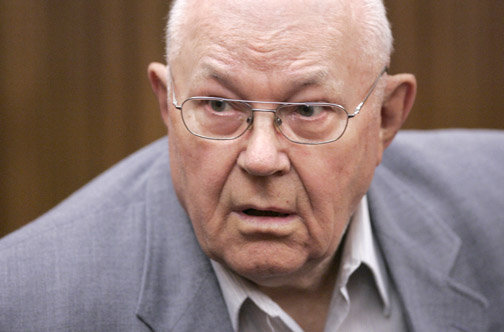 DECLARATION READ TO THE MUNICH COURT
BY A TRANSLATOR ON 13 APRIL 2010
by John Demjanjuk
First posted on www.xoxol.org
DECLARATION of the accused to the criticism of the court and the prosecution of his behaviour during the trial:
I am personallythankful to the people, who are helping me in my hopeless position as a very ill person, be it in prison or be it here in the courtroom. Therefore, I especially thank the medical personnel, who are very helpful in alleviating my major aches and pains and who help me to survive this trial which for me is torture. As a matter of fact, I point out the following:
1. Germany is guilty, that through a war of destruction against the Soviet Union I lost my home and homeland.
2. Germany is guilty of making me become a prisoner of war.
3. Germany is guilty of creating prisoner of war camps where through purposeful denial of enough food rations I and millions of other Red Army prisoners were sentenced to die of starvation and only with God’s help did I survive.
4. Germany is guilty of forcing me to become a slave labourer of the Germans in the prisoner of war camp.
5. Germany is guilty, that in this war of destruction 11 million of my fellow Ukrainians were murdered by the Germans and more millions of Ukrainians, including my loving wife Vera, were abducted to Germany to forced labour and slavery by the Germans.
6. Germany is guilty, that thousands or hundred thousands of my countrymen were made unwilling German collaborators and were forced to join in the perverse genocide program against Jews, Sinti, Roma, Slavs, Ukrainians, Poles and Russians by force and death threats and hundreds and more than hundreds, that wanted to refuse this, were killed for that by the Germans, on top of that hundreds of thousands were deported to Ukraine and executed by Stalin or tortured for ages in the Siberian Gulag and lowered to work as slaves for the Communists.
7. Germany is guilty of forcing me to live a wretched life as a displaced person in a DP camp years after the war.
8. Germany is guilty, that even after 30 years of legal prosecution in Israel, the USA, as well as, Poland and after more than 10 years of imprisonment, more than 5 of those in a death cell in Israel, at the end of my life in my 90th year, I have been forcibly deported to Germany.
9. Germany is guilty, that against me at the end of my life and at the end of my strength false prosecution for accessory to murder has been filed against me under the breach of law of 65 years and against the EMRK of Germany.
10. Germany is guilty for me having to vegetate more than 9 months in Stadelheim, in a prison, isolated, not free — though innocent.
11. Germany is guilty, that I have, without a chance of reversal, forever also lost my second homeland, the USA.
12. Germany is guilty, that I have forever lost the sense of my entire life, my family, my happiness, any kind of future and hope.
I experience every minute, every hour, every day, every week and every month since May 12, 2009 as a prisoner of war in Germany. I experience this process as a continuation of my terrible memories with Germans, as a continuation of the indescribable wrong which has been done to me by Germans. I am again and repeatedly an innocent victim of the Germans. I feel this as an inexpressible wrong that Germany with the help of this trial is making out of me, a prisoner of war, a war criminal. I find it an unbearable arrogance of Germany, that Germany is misusing me to turn the attention away from the war crimes committed by Germans, to make them forgotten and against the truth to claim that the true criminals of the Nazi crimes were me, the Ukrainians and the European neighbours of Nazi Germany.
I consider this trial, which is in breach of the equality of German SS members and a large number of “German Travnikis” is exclusively and only filed against me, an alleged foreign Travniki, which has nothing to do with justice and the law of equality. I have already had to defend myself against the accusation of the Munich prosecutor while in Israel. In Israel, I was accused to be connected to Nazi crimes in Sobibor. The Israeli Supreme Court specifically recognized that this accusation of the Israeli Prosecutor could not be proven and a legal verdict was decided on the Sobibor accusation, and in such a manner taking into account with special reference to the already suffered arrest of more than 7 ½ years. I was jailed in Israel for these charges against me for 7 ½ years with 5 of those years in a death cell.
I feel it is not compatible with fairness and humanity, that for over 35 years I have had to defend myself as a constantly chased legal victim of the Office of Special Investigation of the USA and the circles behind it, especially the World Jewish Congress and the Simon Wiesenthal Centre which live off of the holocaust. Now at the end of my life and the end of my strength, the 30th or 40th trial in the same case is being made and I do not have the strength to fight. I am helpless against this judicial war waged against me for over 30 years which the Germans are now continuing against me in place of the OSI.
Testimony in Demjanjuk (Demjaniuk) Trialhttp://meltingpot.fortunecity.com
T006005 - The 1930's were very tough and very difficult years in Ukraine - collectivization, hunger, millions died. The Soviets set up Machine Tractor Stations (MTS) to supply machinery, experts and operators to the kolhosps.
T006014 - Meisel quotes famine deaths from 2 - 4 million, and there are even higher numbers by Canadian Ukrainian historians of 5 - 10 million.
T006008f
- O'Connor cross-examines Meisel.
- MTS stations were established in 1929 and existed until the 1950's.
- Winter of 1931/32 was harsh; starvation, collectivization, [Soviets?] slaughtered
farm animals.
- Peasants burned their crops. [???] [Olga's
comment: This is NOT believable. Soviets burned the crops so the peasants
would starve.]
- Soviet Union exported wheat while people were starving
T006220f - In 2nd half of 1944, the Germans started changing their approach to the [Slavic] peoples. Vlasov was allowed to create his ROA and the OUN leaders, Melnyk and Bandera, were freed from concentration camps. Skorokotsky(?) and Kubiovich suggested Shandruk as a compromise commander for the Ukrainian Division.
T006222 - The Ukrainian leaders were consistently striving for independence. Bandera's people declared an independent Ukrainian state on June 30, 1941 in Lviv, but the SS destroyed the OUN and arrested its leaders and members. [The Germans were adamantly opposed to Ukrainian independence until the war was irretrievably lost.]
T005974f - Although opposed by Goebbels, Rosenberg, Goering and others,
Himmler rejected the Vlasov idea and set up his own Waffen-SS units.
- There were 12 divisions in 1943 and 30 divisions by end of 1944.
- Himmler started with Norwegians and Danes, then French and Dutch,
and by 1944 he was prepared to enlist Slavs. (Germans refered to them
as Turkmen(?) = Ukrainians, Turkish, Caucasians, Belorusians, Latvians,
Lithuanians, Estonians.)
T006083 - Ukrainians "wanted to set up an independent Ukrainian state divorced from the Soviet Union. Vlasov was against this ..."
T006162 - More than 200,000 of the Poles sent to Siberia were allowed to join "General Anders Polish Army which linked up in the Middle East with the British forces ..." There were also 2 Polish divisions(?) as part of the overall Red Armies. [The starving Poles, who had been sent to Siberia from Western Ukraine in 1939-40, refused to fight for Stalin and insisted on fighting with the Western Allies. Stalin allowed them (as well as Ukrainians and Jews, who latched on) to be evacuated via Iran to Palestine. There, the Jews became AWOL with no questions asked. The others joined Anders Polish Army, were allowed to recuperate, were trained and fought under British overall command.]
T006054 - There was a general pardon for collaborators in 1955 except "In regard to people who had persecuted Soviet citizens or killed Soviet citizens, were not pardoned."[... However, many other UPA members, called Ukrainian bourgeois nationalists or banderivtsi, were not released.]
Testimony in Demjanjuk (Demjaniuk) Trial
http://meltingpot.fortunecity.com
T006005 - The 1930's were very tough and very difficult years in Ukraine - collectivization, hunger, millions died. The Soviets set up Machine Tractor Stations (MTS) to supply machinery, experts and operators to the kolhosps.
T006014 - Meisel quotes famine deaths from 2 - 4 million, and there are even higher numbers by Canadian Ukrainian historians of 5 - 10 million.
T006008f - O'Connor cross-examines Meisel.
- MTS stations were established in 1929 and existed until the 1950's.
- Winter of 1931/32 was harsh; starvation, collectivization, [Soviets?] slaughtered
farm animals.
- Peasants burned their crops. [???] [Olga's
comment: This is NOT believable. Soviets burned the crops so the peasants
would starve.]
- Soviet Union exported wheat while people were starving
T006220f - In 2nd half of 1944, the Germans started changing their approach to the [Slavic] peoples. Vlasov was allowed to create his ROA and the OUN leaders, Melnyk and Bandera, were freed from concentration camps. Skorokotsky(?) and Kubiovich suggested Shandruk as a compromise commander for the Ukrainian Division.
T006222 - The Ukrainian leaders were consistently striving for independence. Bandera's people declared an independent Ukrainian state on June 30, 1941 in Lviv, but the SS destroyed the OUN and arrested its leaders and members. [The Germans were adamantly opposed to Ukrainian independence until the war was irretrievably lost.]
T005974f - Although opposed by Goebbels, Rosenberg, Goering and others,
Himmler rejected the Vlasov idea and set up his own Waffen-SS units.
- There were 12 divisions in 1943 and 30 divisions by end of 1944.
- Himmler started with Norwegians and Danes, then French and Dutch,
and by 1944 he was prepared to enlist Slavs. (Germans refered to them
as Turkmen(?) = Ukrainians, Turkish, Caucasians, Belorusians, Latvians,
Lithuanians, Estonians.)
T006083 - Ukrainians "wanted to set up an independent Ukrainian state divorced from the Soviet Union. Vlasov was against this ..."
T006162 - More than 200,000 of the Poles sent to Siberia were allowed to join "General Anders Polish Army which linked up in the Middle East with the British forces ..." There were also 2 Polish divisions(?) as part of the overall Red Armies. [The starving Poles, who had been sent to Siberia from Western Ukraine in 1939-40, refused to fight for Stalin and insisted on fighting with the Western Allies. Stalin allowed them (as well as Ukrainians and Jews, who latched on) to be evacuated via Iran to Palestine. There, the Jews became AWOL with no questions asked. The others joined Anders Polish Army, were allowed to recuperate, were trained and fought under British overall command.]
T006054 - There was a general pardon for collaborators in 1955 except "In regard to people who had persecuted Soviet citizens or killed Soviet citizens, were not pardoned."[... However, many other UPA members, called Ukrainian bourgeois nationalists or banderivtsi, were not released.]