City archive: Stadtarchiv
Babenhausen
Anschrift: Burgmannenhaus,
Postanschrift: Stadtverwaltung,
Postfach 1109, D-64824
Babenhausen,
Tel. (06073) 602-0
Hessen digital archives dealing with World War II
http://www.stad.hessen.de
"The war was not over, but the great increase in the numbers of prisoners of war was seriously slowing the advance of the American armies. The 106th Division was chosen to handle the influx of prisoners. The Old Guard was given responsibility for camps at Buderich, Limburg, Budesheim, Ditersheim, Mainz, Siershan, Lagstadt, Hergeshausen, Babenhausen, Rheydt, Darmstadt, and others. Literally hundreds of thousands of German prisoner and Russian displaced persons were fed, clothed, medicated, interrogated, classified, and released after April 1945. In the following year, the 3d also assumed responsibility for all Civilian Internee camps in the 7th Army area, a staggering 19 installations, holding 50,000 people, including hospitals, Friendly Witness Barracks, and SS compounds. In all, the Old Guard administered, fed, clothed, and guarded or protected 1,050,000 people in camps scattered over a large part of Germany for a year." from: Military District of Washington, US. Army.
http://www.mdw.army.mil RE: My father's footstepsHello Olga
I am researching my father's history. He left Latvia sometime in 1944 and ended up in Babenhausen Germany in a displaced persons' camp. He came to Australia in 1948 after marrying in Babenhausen. I am trying to find answers to how he would have come to Germany. How did the German army evacuate itself from Latvia in 1944. If he was in the Latvian Army or a partisan group would the Germans have taken Latvians with them or would he have made his own way to Germany and if so how?
I visited Latvia last year and visited a large German war cemetery near where he grew up so I am guessing he was in the middle of the last resistance against the Russians. Also he had ten brothers and sisters and I am wondering why he was the only one to find his way out of Latvia.
Eddie Ozols / Mt Annan NSW AustraliaHello.
Just came across this website. I found a whole bunch of pictures
that my uncle must have taken during WW II. Many of the backs of the photos
are labeled and are of displaced persons camps -- Babenhausen, Lindenfels,
Zeigenheim. They are dated 1946 and 47. There are at least 50 of them.
karen melkonian karenmelkonian@comcast.net
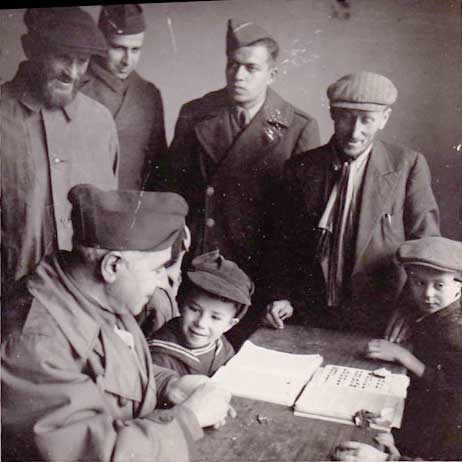
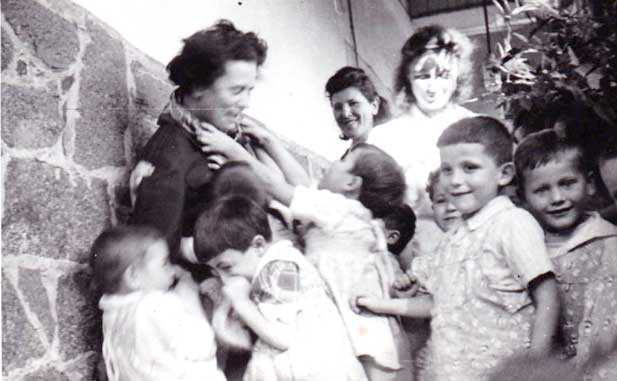
There are lots of pictures of kids. This one is labeled Miss Anda Pinkerfeld (the great poetess) who appears to be a caretaker or teacher.
In the aftermath of World War II, Pinkerfeld-Amir was sent to work in
the Displaced Persons camps in Germany by the Jewish Agency. Pinkerfeld-Amir
kept a diary of her experiences in Europe. She later worked in the archives
of the Ministry of Defense, keeping records of soldiers who fell in the
1948 War of Independence[2].
http://en.wikipedia.org
Bad Aibling Dear Olga, I am researching information on my dad, from Saouglinscheim in Augsburg, Germany in 1949. He obtained foster parents by the names of Anton and Maria Daxenbichler in Bad Aibling. In 1952 he came to the United States. My father's name on his birth certificate was Schibko; his mother's name of Klassen, both from Ukrainia. Thank you very much. Stacy Campbell
Dear Olga,
I would like to trace the IRO Children's Village - Bad Aibling. Rosalia Kiszka, Roman Catholic, resided at Flossenburg, Stanislawa Kiszka who was born in 1946 in Flossenburg, UNRRA lager.Do you know the Roman Catholic Parish for Flossenburg? Anyone know about the Kiszka family in Stryj - Galizien (Galicia); 1846-1912. Death certificate shows Greek Catholic.Any suggestions or information you provide would be greatly appreciated. Thanks Bruce B. Miller
2/15/007 Mrs. Kaczmar,
In 1948, my father, Konstanty Proniewicz, was transferred to
the IRO Children's Village here as an unaccompanied minor, where he
attended school and was processed for transfer to the US in
1950. He also received First Communion as a Catholic here, though I
have no baptismal records of him. His original ethnicity and religion
are unknown, though probably Polish or Belarussian and Jewish. Any
information on this location would be greatly appreciated. Max Monclair http://maxmonclair.blogspot.com
Bad Brückenau - is a spa town in Bad Kissingen district in northwestern Bavaria in the Rhon Mountains. Bad Brückenau is in the tree-line Sinn Valley, in the western Rhon Mountains - this river being a tributary of the Main.[See Wikipedia.]
See archives: www.bad-brueckenau.de
3/7/2022 Hello Olga.
I continue to research my families experience as WW2 forced slave laborers and DP Camp occupants. I was hoping you might be able to identify the badges worn by the young girls in the following picture. My mother Lidia is in the middle of the picture. All girls are wearing the same inverted triangle tip badge.
According to her German work documents, Lidia worked in Bad Brückenau, Germany (near Wurzburg) for a man named Kaspar Karg. Records (small blue book) indicate she was a housekeeper from 1941-1945. I believe this picture was taken in that timeframe.
Thank You, Art Czabaniuk artcz7@gmail.com, Whitmore Lake, MI
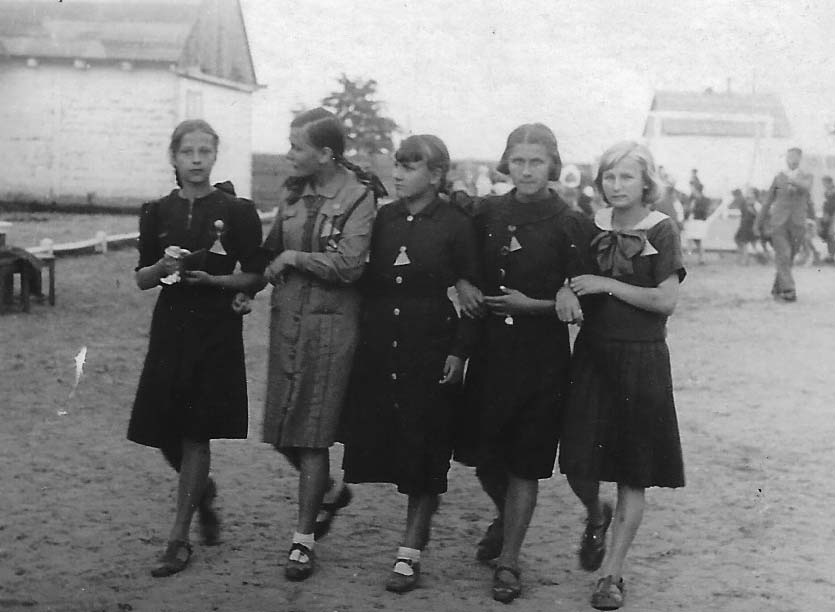
Olga's reply: Since the photo is black and white, it is difficult to see if it is a yellow, white or light colored badge. Inverted triangle badges had many designations according to color and shape. Such emblems helped guards assign tasks to the detainees. For example, a guard at a glance could see if someone were a convicted criminal (green patch) and thus likely of a tough temperament suitable for kapo duty. [See Wikipedia for Nazi concentration camp badge colors.]
US Holocaust Memorial Museum https://encyclopedia.ushmm.org
Bad Cannstadt, Stuttgart
2/10/06 Hi
My parents came to the USA in 1952 from a Displaced Persons Camp located in Bad Canstadt/Stuttgart, Germany. I'm interested in info.
Thank you J. Michael Deigan
Bad Kissingen
City archive: Stadtarchiv
Bad Kissingen
Promenadestr. 6
97688
Bad Kissingen
Tel: 09 71 - 807-140
Fax: 09 71 - 807-149
http://www.badkissingen.de
Hello!! You really have done a great job with your web site and it has helped me understand the beginnings of the aid to refugee programs in post war Germany. Unfortunately, my research is oriented more towards the IRO and in particular, the Headquarters of that organization located in the German town of Bad Kissingen, 1947 - 1949. Can you point me towards any archival sources that discuss this part of the refugee story?
I have seached the web and found very little in detail, the book The International Refugee Organization written by L.W. Holborn is often mentioned. I have yet to locate a copy. The Hulme book, The Wild Place, discusses much of the pre - history to the period I am researching, however, it ends just where the IRO story seems to begin. Can you help me out?? Robert A Stefaowicz
Follow up:
To the best of my knowledge, Bad Kissingen had no camp for displaced persons of any size for any duration. This is not to say that something may have existed for a few months following the war, just that in comparison to the major camps, there was nothing of note.
The Wild Place by Hulme: the book gives a great account of DP Camp at Wildflecken, approx 35 kilometers NW of BK. Hulme's book ends just as the story of the IRO in BK begins. Here is a link if you have not visited this very good site: http://www.dp-camp-wildflecken.de
The former German Army Barracks called Mantueffel Kaserne, located just north of Bad Kissingen, was the home of the Headquarters of the International Refugee Organization that was trying to organize the relief efforts for DPs in the post war period. The American Army was there from 1945 - 1947, then they departed for a few years, that left the area free for the IRO, part of the start-up United Nations. The US Army returns to Manteuffel Kaserne in 1951 and remains until 1991. When the Army moves back to BK, the IRO departs and I believe they considered the DP problem essentially solved by 1951. See my web site at : http://http://www.eaglehorse.org
I have very little on the IRO period. But my site is a good source for information otherwise about the town in the pre and post war years. In particular, see the Home Station folder and the " Hidden Stories " sections. They give you an idea of what was going on in the middle and late 1940s in BK.
The activities of the IRO in the town are largely a mystery to me beyond the fact that as the organization headquarters, it clearly would have processed a lot of paperwork. Bob
I, too, am interested in any research on the dp came at Bad Kissingen. Alexandra T. Gibson Bad Kreuznach Franziska Blum-Gabelmann
Altes Pförtnerhaus im Schlosspark
Raum Dessauerstrasse 49
55543 Bad Kreuznach
stadtarchiv-bad-kreuznach@t-online.de
www.stadt-bad-kreuznach.de
Telefon: 0671 920 77 86
Telefax: 0671 920 77 92
stadtverwaltung@bad-kreuznach.de
"in April 1945, 884th Anti - Aircraft Artillery unit crossed the Rhine at Bingen, having previously administered and policed Bingen and Bad Kreuznach districts. Unit first encountered serious problems - looting, crime - with roving DPs in the Bad Scweppenhausen and surrounding areas." Submitted by: Alan Newark from www.onwar.com
Bad Lippspringe,#3145, L. Niedersachsen (British zone)
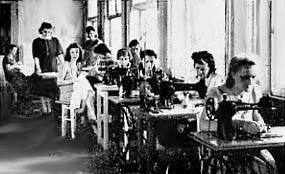
Bad Mergentheim (US zone), Lithuanian
Lithuanian women learn dressmakers' trade in DP camp Bad-MergentheimPhoto from Hearken Then Judge by Juozas Pasilaitis,
submitted by Frank Passic
Bad Nauheim, north of Frankfurt a/M
After World War II, I was an American Officer in charge of publishing Tygodnik Polski and Maly Polak for the 800,000 Polish Displaced Persons in Germany. My editorial office was in Bad Nauheim. I had a Polish major as my chief editor and two Polish women officers in charge of the Maly Polak, a tabloid we used as a book in the camp schools. Upon my return to the United States, I found that all the records of the names of those individuals and the members of the Polish Military company, which distributed the papers in three zones of Germany, were destroyed by a fire where the records had been stored. One of the woman officers was named 'Hanka'. The names of the editor and the other lady officer escape me. I was a captain in the US Army. I would appreciate any information any one may have on any of the people involved. I was most appreciative then and am more so now. Vincent (Witold) Zubras
Bad Oeynhausen, has its own page
Bad Rehberg, #276, Land Niedersachsen (British zone)
Bad Reichenhall (US zone), has its own page Bad Rothenfelde, #266, Land Niedersachsen (British zone)
Bad Salzschlirf, Jews
To Whom It May Concern,
I am looking for information about the Jewish displaced person camp which existed from 1946 until 1949.
I already wrote a book about the Jewish life in my hometown Bad Salzschlirf and during that research I came across this DP camp, but couldn't find any information. The comunity in Bad Salzschlirf says that there are no files or general information though about 1000 Jews lived there. Maybe you can give me some advise or help or know some adresses or emails where I can write to. I thank you in advance for your help. Anja Listmann / Germany Bad Salzuflen City archives: Stadtarchiv
Bad Salzuflen Martin-Luther-Str. 2
D-32105 Bad Salzuflen
Tel: 05222-4839
Fax: 05222-400218
Email: F.Meyer@Bad-Salzuflen.de
Hello,
Here are the original Military
Government for Germany Temporary Travel Document in lieu of
passport for stateless persons and persons of undetermined nationality." There
is a stamp from the IRO, British Visa section and also Canada.
Place of issue was Bad Salzuflen. Alexandra
T. Gibson / Canada
Bad Sassendorf
Bad Windsheim
City archives: Stadtarchiv Neustadt an der AischRathaus, Postfach 1669
91413 Neustadt an der Aisch
7/9/05
Olga, my husband is Ukrainian and was born in a dp camp in Germany in 1946. We need a copy of his birth certificate, but are unable to locate which camp it was. His Baptism Certificate shows Windsheim akr Uffuheim Bayerm. Someone who knew his parents said he was born in Wetsheim. I couldn't locate anything for any of these names. Is there anything I could do with this limited information? Any help would be appreciated. Thanks, BODNIOWYCZ@aol.com
Bad Wörishofen has its own page
Bad Wurzach in Baden-Wurttemberg, (French zone) City web site Click on English translation of city history
Email to the city recorder (Standesamt) riss@bad-wurzach.de
City offices: Stadt
Bad Wurzach
Marktstrasse 16
88 410 Bad Wurzach
Tel.: + 49 (0) 75 64/ 302-0
Fax: + 49 (0) 75 64/ 302-170
Email: stadt@bad-wurzach.de
Bad Zwischenahn, Lithuanians,
Official home page: http://www.bad-zwischenahn.de/
Municiple offices:
Am Brink 9
26160 Bad Zwischenahn
Tel.: 04403/604-0
Fax: 04403/604-444
Email: gemeinde@bad-zwischenahn.de
Chronological history of Bad Zwischenahn http://www.hotel-rosmarin.de/inhalt/geschichte.html
City information: http://cities.eurip.com
2/23/05
I was born in Germany at the camp but came to the United States a few months
after birth. My birth certificate is registered in Bad Zwischenahn but I can't
seem to find their location. Al Grunas
7/17/07
My Father, Aleksander
Markus and his mother Janina Markus, both of Poland, Zofia Schurik
were registered at Bad Zwischenahn. If anyone has any information about
this camp, please write Mark Norek events@lifesanadventure.com.au
Baden Baden (French zone) DPs from Silesia, Hungary and Czechoslovakia (Bohemia and Moravia)
City Archive: Stadtarchiv Baden BadenKüferstr 3
76530 Baden Baden
"Life was more full of hope for the displaced persons from the former German territories in the East and the refugees from the Soviet Zone (by 1951 there had been 1,005,666). From 1945 to the end of 1950 they flowed into the country in several migratory waves, initially almost only to the American Zone, then through resettlement also into the French Zone. (By 1961 the count of new citizens, particularly because of refugees from Middle Germany, rose to 1,620,428." quoted
from: http://www.pantel-web.de
History of Baden: http://www.genealogienetz.de
Baden - Wurttemburg archives:
Konrad-Adenauer-Straße 4
D-70173 Stuttgart
Telefon: 0711/212-4335
Telefax: 0711/212-4360
E-Mail: hstastuttgart@la-bw.de
The Department Central State Archives of Stuttgart (Hauptstaatsarchiv Stuttgart) holds the ministerial archives of the government of Baden-Württemberg and the archives of the former central agencies
Baldersheim, Ochsenfurt - Aub is on the Gollach River, not far from the border of Baden-Württemberg. Aub is divided into three parts: Aub, Baldersheim, and Burgerroth. Aub website: http://www.stadt-aub.de/
Municiple offices: Rathaus, Hauptstr.
42
Zimmer 2 - 4, Erdgeschoss, Tel. 97-25
Email: a.fuchs@stadt-ochsenfurt.de
Baldersheim City website: http://www.baldersheim.de/
1/28/09
My mother was taken from her home in Przemysl, Poland in 1943
and insured at the "Allgemeine Ortskarankenkasse" Marktheidenfeld;
Hasloch. She was registered in Hasloch where
she was forced farm labor at Bernhard Verchs. Later she was
in Baldersheim,
a rural district of Ochsenfurt, resided in house number 62 and
gave birth to my sister. Then she was in a DP Camp Schweinfurt and
in 1946 in a DP Camp Weiden/Oberpfalz. In 1947
she left Camp Weiden for Amberg.
My father was arrested in Radomsk. In 1943 he was sent to Aushwitz. Then in 1943 he was sent to Gusen and in 1943 to Mauthausen, 1943 Weiner Neudorf. In 1945 he was liberated from Mauthausen and he was in DP Camp Schweinfurt, on and in DP Camp Weiden/Oberpfalz. Then in 1947 he left DP Camp Weiden for Amberg, Belguim.
Neither my mother nor my father ever talked about this time. I found out these dates through the Red Cross and Holocaust Tracing. Both of them are now deceased and there is no way of finding out any more information about this time.
Can you give me any suggestions about who I can contact or hire to try to find out about my mother's life in Germany during her forced labor and my sister's birth there? I would appreciate any help you can give me.
Your site is fantastic. You are doing a wonderful job. It is amazing how many people are looking into the past.
Thank you. Helena
Stange hstange@cox.net
Balondorf (U.S. zone)
Bamberg has it own page; (U.S. zone), Ukrainians, Latvian, Jews
Bährendorf#1233
(British zone) Schleswig Holstein region
Barum, #2911, Land Niedersachsen (British zone);
Poles, Balts
Bavaria general research not a camp, but lots of research help; Bavaria is called Bayern by the Germans.
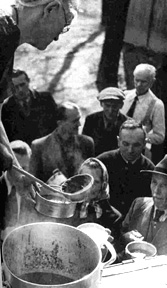
Bahnhoff (train
station) in Bavaria. Feeding
was an immediate task for the Allies. Inmates of German prison and
labor camps were predominantly fed at a train station in Bavaria;
Red Cross served a scoop of mashed potatoes and watery spinach. Photo:
American Friends Serv. Comm. & M. Wyman
Note: Bahnhof is not a town but the German word for Railway station. Wolfgang , author of Post der befreiten Zwangsarbeiter - Displaced Persons Mail Paid in Deutschland 1945 - 1949.
Bayreuth, Ukrainians
City archives: Stadtarchiv Bayreuth, Maximilianstrasse 64, 95444 Bayreuth
City library: Stadtbibliothek Bayreuth, Luitpoldplatz 7, 95444 Bayreuth
University library: Universität
Bayreuth, Zentralbibliothek (central library), Universitätsstrasse
30, 95447 Bayreuth
Dear Olga,
My family and I were in DP camps in several locations after the war: Bamberg, Bayreuth, Fraundorf
and Ansbach. Where can I locate more information about the camps? Thank
you, Hedy Ziemba
Hello Olga.
I was wondering if you could assist me. I am trying to locate information pertaining to Austrian PWs that were held after WWII in the Bayreuth area. I believe they would specifically have been in Bindlach just north of Bayreuth. I have aquired two sketches of a 9th Army Air Force (AAF) Sergeant that are dated 1945 and just outside Bayreuth.
I was stationed there in the 80s and collect items from there. I thought these were interesting just because they were from there and that I have a few other items of the 9th AAF which I knew were at the base in Binlach just after WWII. Upon receiving the sketches, I realized that they were drawn according to the signature by an Austrian PW and it also references two other Austrian PWs. One sketch also references the Sergeant favorably which leads me to believe that this Sergeant must have had a good relationship with the artist as well as the others. It is written on the back of one of the sketches, "Our good Mr. Olson", who is the Sergeant in the sketch. I would like to find this artist if possible. I was wondering if you could tell me where to locate lists or archives with the names of the PWs from Germany and the different areas so that I might discover where this gentleman might have been released or taken. I have just begun my search and will contact Bayreuth as well. I plan on going back this year so I hope to see what archives they might have at that time.
The artist name is Karl Lindken. I cannot help but wonder what happend to this man and his friends. If you know where I might find links to PW or POW art that would be wonderful as I have not found much thus far. Thank you for any help you might provide and great job on the website. A lot of time and effort has gone into it. I salute you. Patrick