We were also in Bad Reichenhall, Hanau, Incikofen.
Warm regards, Maria Nolan / Australia
Ickern (British zone) town
near the city of Castrop-Rauxel
City website: http://www.ickern.de/
Email: info@ickern.de
Lots of coal mine disasters in Ickern.
"As the 89th re-assembled at Ickern, the tide of battle had carried hundreds of miles past the Ruhr, and even now the American Armies were perched on the banks of the Elbe, striving to establish contact with the Russians approaching from the other direction. ...Though Ickern showed all of the effects of aerial and ground warfare, still there were enough areas left intact to provide comfortable living quarters for all the companies, in addition to divisional units." See: http://www.4point2.org/hist-89-p3.htm
Indersdorf (Kloster is Monastery)
https://www.ushmm.org
https://mjhnyc.org
https://fcit.usf.edu
http://www.dpcamps.org
http://kloster-indersdorf-1945-48.blogspot.com
Ingolstadt - Sub area 7 - has its own page.
City archives:
http://www.ingolstadt.de
Stadtarchiv Ingolstadt
Auf der Schanz 45
85049 Ingolstadt
Iserlohn
City archives: Stadtarchiv Iserlohn
Theodor-Heuss-Ring 5
58636 Iserlohn
Tel: (49)-2371-217-1920, -1921, -1922, -1924
Fax: (49)-2371-217-2982
Email: archiv@iserlohn.de
Web: http://www.archive.nrw.de
Isselheide (British zone) - Latvians, http://www.archiv.org.lv
Insula
10/3/04 Hello Olga,
Insula DP Assembly Centerheld 600+ Latvians, some Estonians, and a
few Lithuanians. This camp was in former military barracks and located in Strub
beim Berchtesgaden. I am compiling stories in a book of former Latvian DPs
who were at Insula. You have a good site.
Here are a couple of photos. These photos are 55+ yrs old:
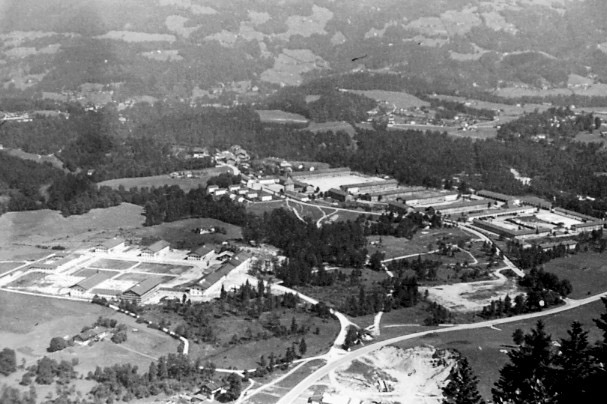
First one shows Insula DP camp lower left, Orlyk is in right center part.
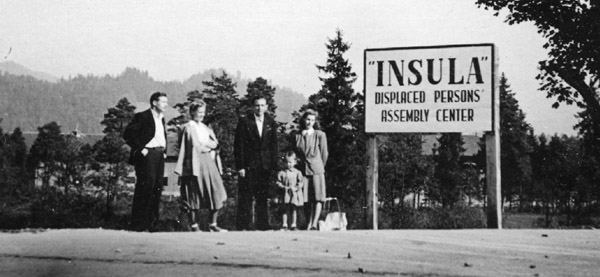
To verify that there was Insula camp, a sign board was erected by the main road, Berchtesgadener Strasse.
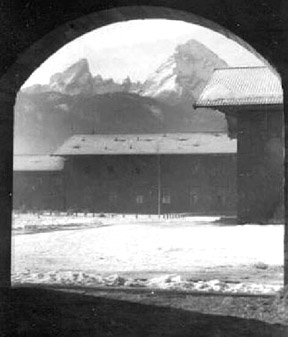
View of Watzmann from DP Camp Insula.
Insula, after closure as a DP camp, was converted to a senior care home and retained its name as Altersheim Insula, operated by Evang -Luth. Diakoniewerk Hohenbrunn. We were not able to located any UNRRA or IRO records about Insula. They are somewhere. Sincerely, Ventis Plume / Anchorage, Alaska
Insula book: World
War II ended in Europe 60 years ago this week. The millions of refugees who
were in Germany included many Latvians. Here are their stories of escape
from their homeland, their survival, and life in the Displaced Persons Camp
called Insula in Berchestgaden, Germany. This long-awaited book, INSULA has
finally arrived. More than 30 people have contributed their stories, written
in English, with many also translated into Latvian. The book includes hundreds
of photos.
For a description of the book and ordering information go to: https://www.kirkhouse.com/ or http://www.latviansonline.com
John Plume plume62@aol.com and Ventis Plume vplume@gci.net Tel:
952.927.4830
Itzehoe - UN camp
#1209, Schleswig Holstein (British zone)
- Latvian residents
(see Slave camps section for more)
Jaegerslust (British zone)
Dear Olga,
I just came across your very interesting webpage on Displaced Persons camps.
I would like to ask you, if you could add the title of my book dealing with the Polish DP camp
Jaegerslust in the Schleswig-Holstein Area in the nothernmost part of Germany. It contains
information about many other DP camps.
Karsten Dölger, "Polenlager
Jägerslust," Polnische Displaced Persons in Schleswig-Holstein 1945
bis 1949, Neumünster
2000.
Yours sincerely Karsten Doelger / Germany
Jena -
Jena was founded quite late, compared to its near neighbour villages, in
the early 2nd millennium. Part of the State of Thuringia from its foundation
in 1920 on, it was incorporated into the German Democratic Republic in
1949 and its district of Gera in 1952. Since 1990, the city of Jena has
been a part of the Free State of Thuringia which is itself part of the
Federal Republic of Germany.Jena is not far from the Hermsdorfer Kreuz
where the A9 (E49/E51) from Berlin to Munich and the A4 (E40) from Frankfurt
to Dresden cross. Just take the way towards Erfurt/Frankfurt.
Jever, #2512, (formerly Hohne), Land Niedersachsen (British zone)
Jöhstadt
Sep 25, 2014
Subject: Great WEBSITE for DP camps.
Dear Olga,
I was born in Munich in 1946 but my family lived in Schleissheim until we emigrated to the U.S. in July 1949. My father was in Klagenfurth before that and my brother was in Johstadt, Germany where he disappeared in April or May 1945 -- unsure of exact month -- at the age of 15. Would like to know how to find MISSING Brother -- do not know if he survived the chaos after the war ended. Bless you for obtaining valuable information that can bring peace to family members who still have questions like myself at age 68. Tanya Milenkovich, tatianakm55@gmail.com.
Jordanbad, UNRRA camp 10 team 209 Jordanbad near Biberach
Dear Madam,
I am glad to find some information about post war DP camps in the internet. Thank you so much. May I inform you about a DP camp which I cannot find in your lists. It was situated in Jordanbad, a former spa near Biberach / Riss in South Germany. It consisted of two camps: camp 10a for
Jews mostly of Austrian or German origin who had so-called "promesas" of
South American states which were not valid anymore. Inmates mostly had
come from German internment camps such as Liebenau, Biberach, Wurzach; camp 10b for Polish Jews who had come from different Nazi concentration camps.
During World War II
more than 2000 Channel Islanders from Guernsey, Jersey and Sark were deported
and interned in Germany by the German Occupying Forces. One of the internment
camps was Lindele Camp, situated informer barracks near Biberach
/ Riss, South Germany.  In
the book, "Das war nicht nur 'Karneval im August'" (see book page), I describe
the backgrounds of the deportations and tell an impressive story about
life in a German internment camp, which was not just 'Carnival in August'
as local eye-witnesses used to call a summer festival in camp in August
1943. In spite of excellent food supply by international organisations,
life behind barbed wire was never without any conflicts and problems. Particularly
during the last months of war, when Biberach Camp was used as a Transit
Camp for Jewish detainees from Bergen-Belsen concentration camp, who were
supposed to be exchanged to Switzerland. Sincerely, Reinhold
Adler
In
the book, "Das war nicht nur 'Karneval im August'" (see book page), I describe
the backgrounds of the deportations and tell an impressive story about
life in a German internment camp, which was not just 'Carnival in August'
as local eye-witnesses used to call a summer festival in camp in August
1943. In spite of excellent food supply by international organisations,
life behind barbed wire was never without any conflicts and problems. Particularly
during the last months of war, when Biberach Camp was used as a Transit
Camp for Jewish detainees from Bergen-Belsen concentration camp, who were
supposed to be exchanged to Switzerland. Sincerely, Reinhold
Adler
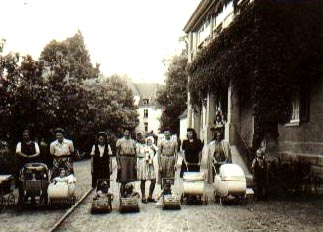
Main building
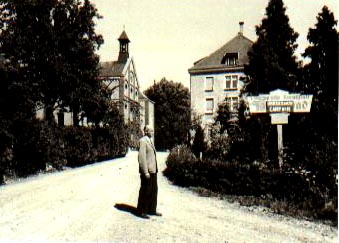
Camp Entrance
The first photo above shows several mothers with their children in front of one of the main buildings. Some women have wooden prams that had been produced by British internees of Biberach internment camp during WW II.
The camp entrance and the camp leader Mr. Max Moses (or Moser).
Documents about UNRRA camp Jordanbad can be found at the following archives: 1) Archiv Kloster Reute, Klostergasse 6, 88339 Bad Waldsee bzw. Postfach 1262, 88331 Bad Waldsee, Germanye-mail: orden@kloster-reute.de
2) UNO Archives and Records Center 1, U.N. Plaza, New York, NY 10017, USA
Jüchen / Juechen