45 camps in 1947. My list is skimpy here. Email me if you find the names of others.
Attichy has its own page.
Beauregard
Brochard 2/4/06 Dear Olga
I found a photo on your site of my dad in the Bockhard site. I think it was
the fourth photo down the page. One of a group of mps at Brochard, one of the
people in it happens to be my dad [the fourth from the left]. Eleanor Roosevelt
is in it with a group with about 16 men and 1 child. Maybe somebody out there
might know something about it. I have been on the net for ten years now with
nothing to show until now. Hopefully this will be the thin edge of the wedge.
I'm enclosing some photos that some people might like to see; hope you can show
them on your site somewhere. Thanks c.hanna
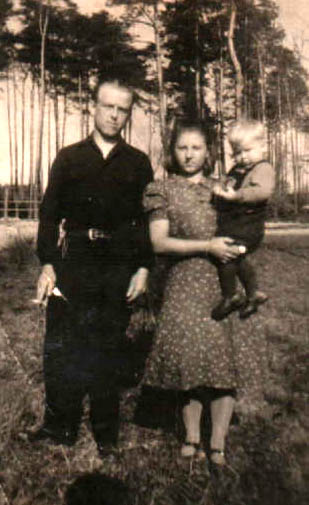
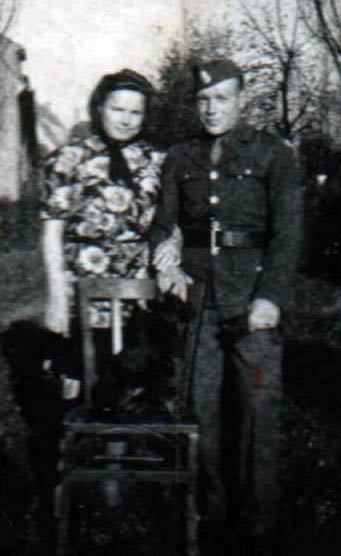
Polish first Holy Communion in Brochard. My elderest sister is in it and also my mum. The rest of the photos I only know that the people in them could be relations.
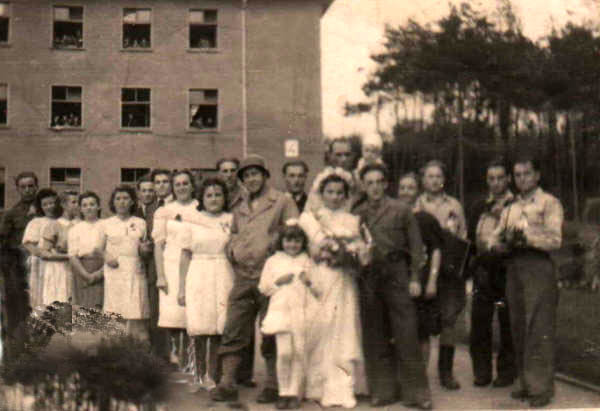
Polish wedding in Brochard My eldest sister is the flower girl in the wedding photo and my mum is in the photo as well.
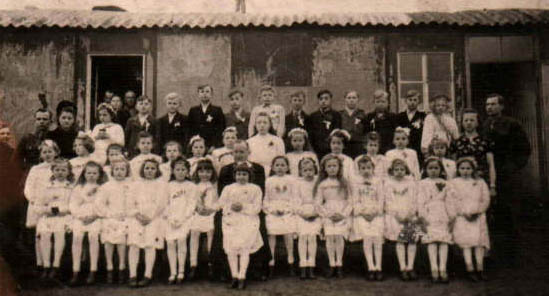
Polish first Holy Communion in Brochard. My elderest sister is in it and also my mum. The rest of the photos I only know that the people in them could be relations.
Chalons
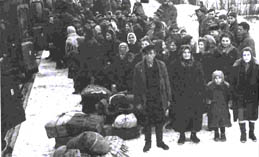
"The Germans used forced labor for a variety of tasks, from building airfields and coastal fortifications, to working in factories. These Soviet(*) forced laborers were liberated near Chalons, France. Many were transported to USSR, some refused repartriation." Photo: National Archives & Mark Wyman
*Olga's comment: They were probably Ukrainian branded by the Russian lable, terrified of Stalin and his well-known eradication of Ukrainians.
Cherbourg DAD, German databank contains emigration to North America through Bremen. The DAD is primarily concerned with the German emigration ports of Bremen/Bremerhaven, Hamburg and Cuxhaven. However, in some cases the ports of Boulogne, Cherbourg, Le Havre or Southampton and others are also recorded as frequently the ships would call at various European ports and take passengers on board before crossing the Atlantic. The passenger lists were always written in English.
Cherbourg was the first large city liberated in France: "General conditions. Although damage to the city, about 25 percent, was less than expected, the population had been reduced, chiefly by forced evacuation, from about 40,000 to about 5,000. The remaining inhabitants were patriots who, evading German evacuation orders, had stayed to witness the liberation. Civilian casualties were light, and most of the wounded could be cared for in civilian hospitals. Food for 30 days was available. Some looting occurred during the first few days after the surrender, but police were functioning and law and order were maintained. Public health administration as well as most civilian community functions and services suffered from lack of transportation and poor communications. Early restoration of newspapers, movies, radio, and courts was achieved. " See http://history.amedd.army.mil
Drancy
(outside of Paris)
On 1/11/11
Hello, Bonjour
Je suis à la recherche d'une liste de prisonniers de confession juive à Drancy
Nom: Majtelès Tobias
son épouse Rack Divojra aviat réussi à le
faire sortir du camp
*mes Grand-parents ont caché cette famille pendant l'occupation en Sarthe
Merci pour votre aide
M.Busson zltvc72@gmail.com
In English
Hello, I am with research d' a list of prisoners
of Jewish confession in Drancy (Suburb of Paris) Name: Majtelès
Tobias his wife Divojra Rack aviat succeeded in leaving the
camp Thank you for your assistance M.Busson *mes Grand-parents
hid this family during occupation in the Sarthe (France)
http://en.wikipedia.org
Frankreich - Jullouville, Normandie, France
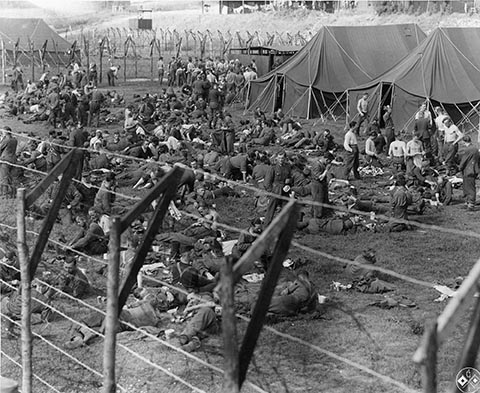
Jullouville UNNRA Training Center: http://www.crommelin.org
Grandes Arenas Embarkment Camp
La Vernet - Internment camp; 1939-1944
Metz has its own page Archives Municipales
Chef de service : M. LUCAS
Conservateur responsable du service des archives : Mlle BARTHEL
1-3 rue des Recollets
57000 METZ
Mairie de Metz
BP 21025
57036 METZ
Tel. 03 87 68 25 70
Fax. 03 87 75 30 73
Contacter ce service par e-mail: rarchives@mairie-metz.fr
Hallo,
My name is Roland Zimmer, You wrote about a French-Soviet raid (Repatriation
page) on a dp-camp in Metz. Do you know the name of the camp? Do you
know where it was located at? Was it in the city of Metz or in the area
around Metz? Are still people alive who could identify the camp on a
picture? Thank you very much for any answer.
With regards Roland Zimmer /
Germany
http://www.tankbooks.com
http://www.8th-armored.org
http://www.89infdivww2.org
http://www.well.com
Natsweiller article in French: http://www.alsapresse.com
St. Jerome, DP holding camps
Book: UKRAINIANS IN FRANCE Desiat' rokiv pratsi.
Natsionalistychne Vydavnytstvo v Evropi.
54s. 21tsm. Language--U. Paryzh, 1959.
Ukrainets' u Frantsii: Ukrains'ko-frantsuz'kyi poradnyk. Petrenko, F.
Ukrains'ka Vyzvol'na biblioteka.
64s. 22sm. poor condition. Language--U. Paryzh, 1933.
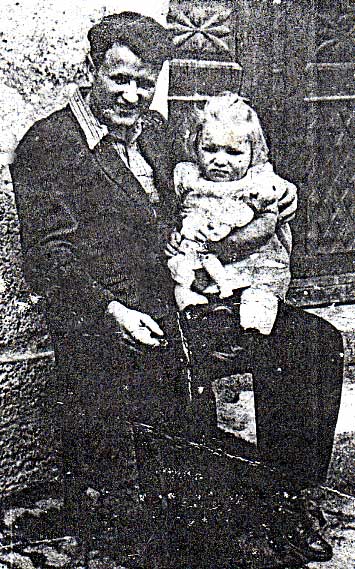
Missing Person
Attn: Kaczmars
in France:
Emilion Kaczmar's daughter in France, please notify me immediately. Your half sister wants to write to you before she dies. Send your photo. I will give you the address. Your two half brothers have already died. okaczmar@gmail.com
Seven to nine million people were displaced by the end of the war. At the
end of 1945, 1.5 to 2 million displaced persons (DPs) did not want to return
to their homes, fearing economic and social repercussions, or even annihilation.
About ten percent of these people were Jewish.
The British changed plans and sent the Exodus prisoners to Port de Bouc in southern France, where they had first embarked. Gruber rushed there from Cyprus. When the prison ships arrived, the prisoners refused to disembark. After 18 days in which the refugees endured the blistering heat, the British decided to ship the Jews back to Germany.
The French reject the British demand to land the passengers. 4,500 Jews anchored off the French coast leave for Israel. Between 1948 and 1951, almost 700,000 Jews emigrate to Israel, including more than two-thirds of the Jewish displaced persons in Europe.
Thanks to the French Socialist Party we were able to secure 1,200 more visas for our D.P.'s in the camps who will now be permitted to settle in France. People have to be selected and examined medically. Then we must find transportation to France and provide new arrivals with apartments and work. photo story
Ukraine Europe Website -general URL -(SUI's Website - Ukrainian information
service in France - and French speaking Ukrainian diaspora's website) (Portal page)
Ukraine-Europe.org
Ukrainian organizations in France and Belgium
Ukraine-Europe dossiers
Ukrainian genealogy (no pages about Ukrainian genealogy in France but only for research in Ukraine, Poland... and a research forum at this URL page 115
Best regards from our diaspora and
J.CHEVTCHENKO (Shevchenko)
Ukraine Europe Web Content Manager
President de l'Union des Francais d'Origine Ukrainienne
Directeur du Service Ukrainien d'Information - France
2/4/06
Hi, I'm writing up my father's memoirs about the war. He tells of Germans in a POW camp in France near a place called Arvenge or Arvange. He can't remember the name exactly. I am trying to find out the real name of that city or village. He landed with the Dutch Brigade in Normandy, one or two months after D-Day, and then fought with them through northern France, so I think the town must be a northern one. Any help would be appreciated.
Very important page: Immigration records and archives in France
BB36 - Proces Rochling devant le tribunal general du gouvernement militaire de
Rastatt (1914-1948).
http://www.histoire-genealogie.com
Submitted by Alan Newark braveheart180203@hotmail.com
http://history.amedd.army.mil
Displaced persons and refugees-
Large numbers of refugees and ambulatory civilian casualties attempted to return to their homes unaided. It was necessary to clear them out of the way of military operations and to supervise and control their movements. For these purposes, CAD's C112 and D212 became "refugee control detachments" in August 1944, with the special mission of establishing routes over which a quarter of a million refugees and thousands of wounded and sick were kept away from military lines.
Groups of refugees were brought under control in the French communities, and were cared for through the Maires, the Secours National, and the Croix Rouge Francaise, under guidance and supervision of CAD's, which billeted and fed them without military assistance.
In only two instances was it necessary for the G-5 Section of the Third U.S. Army to furnish relief supplies.8
6A Field Headquarters of the United States of America Typhus Commission (which had been established by Executive Order No. 9285 by President FranklinD. Roosevelt on 24 December 1942) was established in London in May 1944. While retaining its integrity and scope as a miscellaneous activity of the War Department, the Commission was attached to the Public Health Branch, G-5 SHAEF.
During the rest of the war, the Commission worked closely with this Branch, the ECA Medical Detachments and Groups, the regular theater Medical Service, and various civilian organizations, to prevent and control typhus fever in the European theater.
A detailed account of this is given by the former Director of the Commission, Brig. Gen. S. Bayne-Jones, USAR (Ret.), in Medical Department, United States Army. Preventive Medicine in World War II. Volume VII. Communicable Diseases: Arthropodborne Diseases Other Than Malaria. Washington: U.S. Government Printing Office, 1964, ch. X.
7Report, Maj. Theodore E. Woodward, MC, to Public Health Branch, G-5, SHAEF, July 1944, subject: Typhus Control.
441
One of these situations occurred at Brest [France]:
A special problem developed in the vicinity of Brest when the Germans expelled the city's civilian population in the probable hope of embarrassing the American forces. [Civil Affairs] Detachment C112 was dispatched to this area and the G-5 Refugee officer, together with a French liaison officer, surveyed the area. Instructions were issued to the Maires and the Chief of Gendarmes of each community to clear the main highways and route individuals to communities where billeting facilities still existed.
Six thousand refugees were entrained from Landerneau to Morlaix.
The refugees which came through the German lines were excellently handled by the French Authorities, with the assistance of four women of the Military Liaison for Administrative Matters, through dispersal and billeting in nearby communities.
Detachment C112 provided emergency hard rations, which included soap, codfish, pulses, biscuits, meat, milk, and chocolate. Its officers coordinated the work of the Maires.
The Secours National established emergency feeding stations where necessary and a total of 24,000 refugees were cared for without interference to military operations or supply, and without suffering to the individual.9
Along the battlelines, control routes were established for moving refugees to nearby transit camps, where they were kept for a few days before being moved to more permanent camps. These camps were operated by Free French volunteers, at first under the jurisdiction of CAD's or military authorities. As the combat lines advanced, the camps were transferred to civil authorities as temporary places for refugees until more permanent homes could be found for them. Military transport was used to move medical and sanitary supplies from civilian and Civil Affairs sources. In crowded situations, the refugees slept on floors or on straw for a day or two, but cots and tents were provided later. In addition, during this period, Civil Affairs Detachments became responsible for the civilians in the internment camps which were uncovered as the troops moved forward.
Camps for displaced persons and refugees, which usually operated under Army control, included dispensaries. The ARB and CAD public health and medical supply units proved too large for meeting emergency medical needs. Therefore, a drug unit was augmented by dressings and other items and small "dispensary units" were set up. These were the Civil Affairs medical kits, which were found to be particularly convenient and useful. Likewise, refugee camps were managed satisfactorily largely by local physicians under the general supervision of Civil Affairs officers.Invasion of Southern France
The Seventh U.S. Army landed on the coast of southern France, near Toulon and Marseille, on 15 August 1944, commencing Operation ANVIL.
8(1) After Action Report, Third U.S. Army, 1 August 1944-9 May 1945. Vol. II. Staff Section Reports, G-5 Section, Ch. 3. August Operations, Sec. IV, Refugees and Displaced Persons, p. 6. (2) Note:
The G-5 Section of the After Action Report of the Third U.S. Army contains monthly summaries of events and operations with much information about civilian conditions, Civil Affairs, Military Government, and Public Health activities in France and Germany. The relationships between G-5 Army and G-5 SHAEF are clearly indicated, although the whole story is not told-S. B-J.
Movements into France-Civil affairs-public health personnel of the European Civil Affairs Division moved into France with the division and its regiments, companies, and detachments. A forward echelon of Headquarters, ECAD, established on 8 June 1944 at Shrivenham, England, proceeded to Omaha Beach on 21 July to administer ECAD elements in the field and to inspect, advise, and assist in Civil Affairs operations, supply, administration, and personnel problems.
The Assistant Division Surgeon and six enlisted men, who operated from Chateau Epinquet until 4 September, comprised the Medical Department component of the Forward Echelon until headquarters was set up at Rochefort-en-Yvelines to accommodate Headquarters, ECAD, when it arrived on 9 September. An advance echelon of the 1st ECA Medical Detachment, 1st ECA Regiment, with two auxiliary public health teams, arrived in France on 24 June, and the remainder of the detachment, commanded by Lt. Col. (later Col.) William H. Riheldaffer, MC, debarked at Omaha Beach on 30 June. The 2d ECA Medical Detachment, 2d ECA Regiment, commanded by Lt. Col. Roswell K. Brown, MC, arrived at Utah Beach on 13 July, and the 4th and 3d ECA Medical Detachments arrived at Rochefort-en-Yvelines on 17 and 19 September, respectively.
Personnel
The Civil Affairs Center at Shrivenham had no table of organization or table of distribution for personnel spaces and grades. Therefore, there were no position vacancies, and no promotions could be made. Activation of ECAD with a table of distribution on 6 February 1944 was followed by only four promotions. Theoretically, promotions were possible, but more personnel were assigned without proportionate increases in authorizations for grades and ratings. Medical personnel were promoted after activation of the ECA Medical Group.
Use of enlisted personnel.-The evolution and development of the use of Medical Department enlisted personnel in Civil Affairs, to supplement activities of officers, were important factors in civil affairs-public health activities in northwest Europe; no medical enlisted personnel were used in the Italian campaign. A wider coverage was obtained by having, on each CA/MG detachment, a Medical Department enlisted man who rendered first aid and collected and assembled data for the officer responsible for the detachment's area. Frequently these enlisted men were not used sufficiently, primarily because an understanding of their capabilities was lacking.
Functions.-Specific functions of the ECA Medical Group included giving technical public health advice in planning, organizing, and supervising the territorial application of principles of public health in liberated and occupied lands from frontlines to rear areas and zones.
The ECA Medical Group enabled SHAEF to provide personnel, units, and teams to operate with CA/MG regional detachments or teams in reestablishing civil public health and in preventing the development of hazardous health conditions that might interfere with military operations.
The Group provided personnel for technical supervision of public health operations, prepared technical directives to implement public health functions, and furnished qualified personnel to supervise and review results in the field and to obtain and interpret information on prevention and control of disease. The Group also provided personnel for consultations and conferences with responsible civilian health authorities, and assisted in coordinating the similar public health programs and activities of the Allied armies.
In carrying out these functions, many difficulties had to be overcome. Coordination of efforts and supervision of personnel were especially difficult because of poor communication and limited contact among personnel of the Civil Affairs Detachments. Rapid movement, fluid combat situations, and limited communications demanded individual reconnaissance and direct contact if the job were to be done.
During the period between the liberation of Paris on 25-28 August 1944 and the middle of December, the Allied armies advanced to the northern and eastern borders of Belgium and France and were in the early stages of the planned alinement along the western bank of the Rhine. In this interval, extensive civil affairs-public health operations had been carried out by both the regular medical service of the field armies and by the public health organizations of G-5 SHAEF (p. 444).