Primary investigator: Alan Newark braveheart562002@yahoo.com
Auschwitz held Ukrainian prisoners but the official record doesn't show it "Inside the prison cells I saw what had been done to our priests. Crude crosses had been carved into their chests before they were done in. The walls of the cells were spattered with dried blood and there were holes in the walls as if from bullets. In one cell there was a large pool of coagulated blood on the floor. This was a place where many people had been slaughtered. The corpses we uncovered were already decomposing, but we could see that some of these victims had their eyes torn out or their seual organs mutilated, had their faces and bones crushed with rifle butts, men and women alike. ...Some innocents had been dismembered, buchered, mutilated. The stench..." Into Auschwitz, for Ukraine By Stefan Petelycky
Bazar, Executions at Bazar recalled 80 years later
by Danylo Kulyniak
Copyright © The Ukrainian Weekly
December 9, 2001, No. 49, Vol. LXIX
Special to The Ukrainian Weekly
BAZAR, Ukraine - Eighty years ago, on November 21, 1921, in the city of Bazar in the Zhytomyr Oblast of Ukraine, Bolshevik troops executed 359 prisoners of war, members of the Ukrainian Army of the Ukrainian National Republic who were part of the winter campaign against the Communist invaders.
The Ukrainian soldiers chose death over a compromise of their priniciples and beliefs, and turned down a deal that would have saved their lives by refusing to transfer to the ranks of the Communists.
The tragedy was remembered this November 21, at the site where the men were butchered, today marked by two large communal graves ("bratski mohyly"), a large monument and several crosses. Eight decades later some 1,000 Ukrainians who have not forgotten their heroes came by bus from cities across Ukraine - Kyiv, Odesa, Uzyn, Cherkasy, Zhytomyr, Lviv, Lutsk, Ternopil, Rivne, Ivano-Frankivsk and other cities - to pay their respects.
The monument was erected only last year thanks to contributions by Ukrainians living in Great Britain. The names of the 359 heroes are engraved in gold on the large black marker.
From the perspective of history it is now obvious that the military situation at the time was such that there was little chance the second winter campaign led by Lt. Gen. Yurii Tiutiunnyk of the Ukrainian National Republic would be successful.
Thousands of poorly armed, underdressed and underfed men went forward in the last days before winter to confront the Bolshevik Red Army, which had amassed tens of thousands of troops for battle against the partisans. Merely two weeks after the campaign began, the contingent was destroyed by the Soviet Second Red Cavalry Brigade of Gen. Hryhorii Kotovsky.
Hundreds were killed and hundreds more taken prisoner before the battle ended. The 359 imprisoned were escorted to a field outside the village of Bazar on November 21 to be executed, but first Gen. Kotovsky gave them the chance to cross over and join the Red Army. None agreed to do so and all were shot as they sang the Ukrainian national hymn "Sche Ne Vmerla Ukraina."
Only four years had passed since a similar tragedy had taken place at Kruty, just outside of Kyiv, pitting a force of college and high school students at the beginning of the war against the Bolsheviks. The battles of Kruty and Bazar both ended in tragedy, with the execution of imprisoned Ukrainian patriots. During those four years a whole epoch of Ukrainian history passed; the Bazar tragedy was the finale.
But the tragic history of Bazar does not end there in 1921. In 1941, after Ukrainian patriot and nationalist Oleh Kandyba Olzhych, organized 20th anniversary commemmorations of the event at the site of the executions, German Nazi authorities, who by that time had occupied Ukraine, arrested some 721 people who had taken part in the memorial services. They were executed by the Nazis several days later in Zhytomyr.
Butovo-- Stalin's victims
"...50 years after Stalin's death, his victims have no national memorial. In Moscow alone there are two sites where mass killings were carried out in the 1930s on Stalin's orders, but no memorials to the thousands who died there. In one of them, less than 20 miles south of in a place overgrown with tall weeds. Another, called Butovo, is just outside the city. When I went there last summer, I missed the sign and stopped to ask a policemen and several others. All just shrugged. Imagine losing your way on the road to Dachau and realizing nobody had the slightest idea what you were talking about.
Once on the Butovo site you see no tourists. The space is vast, with the unevenness of the ground hinting at what lies beneath. The place has been handed over to the Russian Orthodox Church, but the church takes a selective approach: Only clergymen are commemorated in a place where more than 20,000 people were shot and buried in 1937-38. There are no other names anywhere."
Masha Lipman, a Russian journalist, writes a monthly column for The Post.
The Washington Post, Washington, D.C., March 5, 2003
Brody, Stalino coal mines, Darniza Camp, Bunker camp, Kharkov and Kiev Camp 8, Memoirs of Roman Stocklein, a German soldier held captive in Russian POW camps
http://home.arcor.de
Very
informative and enlightening. If you ever feel sorry for yourself, read these
real troubles.
And other stories: http://home.arcor.de
GPU Camps in Ural: Looking for survivors I was a Red Army soldier, I fall (wounded) in German Captivity on July 1941 (at the s.c. "Vitiebskoye Okruzhenie"). I was in German captivity for about 3 1/2 years. I escaped in January 1945 and then I was sent to the GPU Camps in Ural (camp # 4, than camp #245) and finally in camp #0305 in Severouralsk.
I have a diary which I have written at that time (mostly Russian). I would like former inmates (if they are still alive) to write to me. Thank you. Dr. I. Machtey
Kharkov prison: Grigg, William Norman
Copyright The New American Apr 19, 2004
"Slavomir Rawicz was transferred to an immense fortress prison in Kharkov, Ukraine, where he became the personal project of a huge, muscular - and inventively sadistic - NKVD major known as "The Bull." "He ran his interrogation sessions like an eminent surgeon, always showing off his skill before a changing crowd of junior officers," reflected Rawicz. "His methods were despicably ingenious."
"One of The Bull's preferred methods of breaking his subjects' will was to insert them in a kishka, a chimney-like subterranean cell that permitted a man to stand, but not move. No provision was made for the inmates' bodily functions, and the kishkas were never cleaned. Each day, Rawicz would be hauled out of his tiny cell, hosed off, and sent to The Bull for interrogation and torture. And each day The Bull's profane anger with Rawicz grew as beatings, pistol-whippings, and cunning torments involving water and lights failed to induce the innocent man to sign a confession. "All you have to do is put your name here and I will leave you alone," the torturer frequently bellowed as he shoved a thick finger at the confession."
Kolyma: "But the most savage death toll came later, in slave camps of Kolyma and Uzbekistan, where inmates, women, men and children never survived longer than two years. In the Kolyma gold mines, the annual death rate of Polish slaves alone rose to more than 50 percent in 1940. After 8 hours of inhumanly hard work, they received a bowl of potato soup and a slice of frozen black bread. My relative survived the Siberian death camp because he ate raw dead owls and small rodents. In the death and labor camps of Kolyma more than 3 million prisoners died between 1935 and 1955. Polish, German, Rumanian and Finnish war prisoners who worked in the gold fields were the third generation of Soviet slaves. Working bulldozers sometimes excavated a huge mass grave and scraped up these stiffened bodies, thousands of bodies, thousands of skeletal corpses, twisted fingers, putrefying toes, frozen stumps, the dry skin scored with blood, and hungry blazing eyes."
50 years on, Stalin casts a shadow over Russia,
Agence France-Presse (AFP), Moscow, Russia, March 2, 2003
Luft (Stalag Luft I) in Barth, Germany: See http://www.merkki.com/
Moscow camp
On 10/27/12 Dear Olga,
I have a German
friend who was a POW in a camp in Russia – the only designation
my friend remembers is that it was called Camp
73. Have you ever
heard of such a camp? It was east of Moscow, and the German soldiers
were forced to work in a coal mine. My friend escaped
with some others and was able to make it back to Germany on
foot…
I’m desperately trying to find it, and any other possible survivors, or what happened to the men who were imprisoned there. My friend is very reluctant to speak much about the experience, and will not sit for an interview or authorize a book - simply too traumatic. Over the years my friend has confided bits and pieces of the story to me and feels sure all the ones who remained in Camp 73 died in Camp 73. My friend thinks that Camp 73 only housed SS troops, possibly only 18th SS Panzegrenadier Division Horst Wessel soldiers. As I said, your assistance is greatly appreciated. Finding it and/or survivors might help my friend heal. Who knows? Warmest regards,
Reply from Olga: http://www.dpcamps.org
From: Alan
Newark braveheart180203@hotmail.com
http://www.sonderarchiv.de/benutzung.htm
Special Archive Moscow - Notes on Usage
The use of written request addressed to the head of the Russian State Military Archive, which the "Special Archive" was incorporated, Mr. Vladimir Nikolayevich Kuselenkow is present on site. The address is:
Russia 212125
Moscow
Ul. Korp Vyborgskaya 3, 1
Russian State Military Archive
Mr. WN Kuselenkow
Deputy Director for the Department of Special
Archive is Mr. Vladimir
Ivanovich Korotayev.
Military and special archive have in the home pagein
Russian, on the address, opening times, officers, and
email address rgvarchive@mtu-net.ru listed,
as well as telephone and fax numbers are.
By link, there is also information on the history of the stock and the working conditions of the archive. Finally, the page provides the ability to directly via email formto submit an inquiry to the archive.
For the work in the archives basic knowledge of Russian language
or an interpreter or translator is essential.
Firstly, all finding aids are written in Russian, on the other
hand, the archive staff only speak Russian.
The Archives is open Monday to Thursday from 10 to 17
clock, Fridays 10-16 clock. The first working day of
every month "Sanitätstag" is
where the archive is closed.
It is strongly advised that in July and August not provide for work in the "Special Archive". In these summer months, the archive is often closed for weeks, with the closing times can be set or changed at short notice.
Russian Archives
http://www.russianarchives.com
Norilsk camp When Stalin died in 1953, Shumuk was one of the leaders of prison uprisings in Norilsk. Outbreaks like those throughout the GULAG led to a wide-ranging release of prisoners; except for those who remained defiant and therefore free, barbed wire notwithstanding.
Andrew Fedynsky is director of the Ukrainian Museum-Archives in Cleveland, Ohio. The museum's website: http://www.umacleveland.org/
PERSPECTIVES, by Andrew Fedynsky The Ukrainian Weekly, Ukrainian National Association Parsippany, New Jersey, Sunday, March 2, 2003:
Danylo Shumuk, now nearly 90 years old, was 19 when he was first arrested and imprisoned in 1934. Eventually, he became the longest-serving prisoner of conscience in the former Soviet Union, spending 42 years in prison or exile. It was in the Norilsk labor camp north of the Arctic Circle in 1945. In the early morning darkness of the Siberian winter, he and his newly-arrived fellows were mustered to watch as the guards dragged two bodies from the disciplinary cell, deposited them in front of the assembled prisoners and sank their bayonets into the half-frozen corpses.
"Smotriti! - Watch well," the commandant shouted at the inmates, who ached from weariness and cold. "This is the only way you'll ever get out of this place!" That, Shumuk said, was the low point of his life.
Failure to achieve that was blamed on the "enemies of the people," who were then put to work building Siberia's infrastructure, where much of the country's lumber, coal, copper, gold and other minerals were located.
Stalin's slaves dug the White Sea-Baltic and the Moscow-Volga Canals, laid railroad track, constructed strategic roads, factories and hydroelectric stations. Danylo Shumuk was in Norilsk to work in the mines, which were supplying the Soviet arms industry with nickel, molybdenum and chrome.
Life outside the camps was better only by degree. Soviet citizens suffered from crowded living quarters, a shortage of consumer goods, oppressive and dangerous labor conditions, and no freedom whatsoever. Social discourse, artistic expression, everything was monitored by the state. Even children were taught to inform on their parents. The CHEKA morphed into the GPU, then the NKVD and finally, the KGB, but it was always the same organization, which existed to terrorize and control.
Neubrandenburg - former water mill and hydroelectric plant today, subcamp of Ravensbrück
During World War II, a large prisoner-of-war camp Stalag II-A was located close to the town. In 1945, few days before the end of World War II, 80% of the old town was burned down by the Red Army in a great fire. In that course, about 600 people committed suicide.[3] Since then, most buildings of historical relevance have been rebuilt. http://uk.ask.com
Submitted by: Alan Newark braveheart562002@yahoo.com
Wikipedia extracts: Soviet repression NKVD repression / Neubrandenburg Camp
New Kaliss......County of Ludwigslust-Parchim, Mecklenburg-Western Pomerani
In 1799 the first paper mill was built in the resort, which
also exploited the power of the water channel.
In 1871, the Dürener
Felix Heinrich Schoeller and Theodor Bausch fine paper mill Felix Schoeller & Bausch
founded. In this mill Mecklenburg paper was produced. The excellent
quality of the paper with the Mecklenburg bull's head watermark gained a
great reputation in the German market. The company was one of the early leading
paper manufacturer in Germany. This fine specialty papers soon
was exported to distant countries. After World War II, instead of rags,
wood and straw pulp were used for paper production.
After the Second World War, the factory survived unscathed, but the machines were dismantled in 1946, sent in 650 freight cars to the Soviet Union as reparation. Only in 1951, despite the scarcity of material for reconstruction of the factory, Bausch Viktor with his engineer and the entire staff Frenkel [2] resurrected the paper production. Shortly afterward, the factory was expropriated and nationalized.
After Rudolf Bausch, CEO of the company and Viktor Bausch's brother, in 1945 following a denunciation by the NKVD in the main camp at Neubrandenburg / Five Oaks had been deported (where he died in 1946 [3] ), had now Victor and the remaining members of the family Bausch New Kaliß leave. [4] Production continuied until in 1990 and 1992, the company was acquired and privatized by the Melitta Group companies and in 1995 a completely new factory was erected in this town.
Parchim - Mecklenburg - West Pomerania
Submitted by: Alan Newark braveheart562002@yahoo.com (computer
translated).
Jewish persecutions; on average 15,000 WWII Allied POWs; Bramfeld forced labour camp for Soviet and Polish men and women and a transit camp (no memorial) holding over time 50,000 foreign forced labourers used by Nazi era arms factories; in Soviet era NKVD prison
Water Tower of 1906 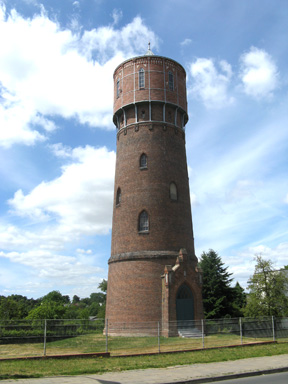
In 1905 the villa was converted into a hospital, Heucke. The city
had 12,805 inhabitants around 1910. Between 1906 and 1921 Parchim received
electricity from this powerplant. In 1925 Parchim became the county
sea but it didn't get a new building for the district office until 1936
With the start of World War II, on the outskirts of Parchim the former cavalry parade ground was one of the largest POW camp in Germany with a capacity of up to 25,000 prisoners. Under bleak conditions at times 15 000 prisoners of war were housed here from Russia, France, Belgium, Serbia and England. A total of 1402 of them died here. A cemetery and a monument Dammer Weg, was built with donations from the inmates at the camp and ordained on 4 June 1916. The city of Parchim cares and maintains it since 1922.
Mid-1937 was developed by the Air Force of the airfield Parchim put into operation. The Nazi terror in Parchim recorded: 1937, 22 Jewish families were abused, and emigrated or were deported to in a concentration camp. During the November 1938 pogrom, the Jewish cemetery was desecrated and destroyed.
From 1939 to 1945, a forced labor camp in Bramfeld was run in which about 1,000 Polish and Soviet women and men were housed. They had to perform forced labor in armaments areas. In addition, a transit camp for foreign forced laborers was established which housed some 50,000 people. No sign of remembrance commemorates them except for a grave stone . The Second World War left the city itself largely undamaged.
On the 3rd May 1945 came the Red Army. The airfield was used from 1945 to 1992 by Soviet air forces.
In the Schwerin Street 3 / 4, built during the Soviet occupation, the Soviet secret police, NKVD, held in the basement jail allegedly anti-Soviet detainees for brutal interrogations. A plaque was rected in 1993.
In 1951, the teachers at the high school, Erich Creutzfeldt and Dr. Karl
Richter, were arrested with others in Parchim. Sentenced to 20 years hard
labor, they were deported to the Siberian camps Taishet in the USSR, where
judges fell ill and died Creutzfeldt strong. [4]
Pechora camp
Perm-36: History of a Camp Monday, September 29 -- Friday, October 3, 2003. Russell Senate Office Building Rotunda. Capitol Hill, Washington, DC
The Perm-36 Memorial Museum of Political Repression and Totalitarianism is one of only a few labor camps still standing and the only camp restored as a memorial to the tens of millions of people who suffered and died in the Soviet Gulag.
This exhibit, which will be open to the public, tells the story of the GULAG as it is reflected in the history of the Perm-36 camp near the village of Kuchino in Perm Oblast.
Also, in connection with the exhibit, there will be a roundtable, "The Political Legacy of the Soviet Gulag," on October 1, in the Senate Russell Caucus Room, room 325 of the Russell Building. This roundtable will feature presentations by Anne Applebaum, author of GULAG: A History, and Yuri Dzhibladze of the Center for Development of Democracy and Human Rights in Moscow. Roundtable discussants will include Victor Shmyrov, the director of the Perm-36 Museum, and David Satter, author of Darkness at Dawn: The Rise of the Russian Criminal State.
E-Poshta, September 27, 2003, Vol.4, No. 88
Myroslava_e-poshta-canadaus@yahoogroups.com
Perm-36, Russia by Adam B. Ellick: Special to the Jewish Times SEPTEMBER 24, 2003
Because of the secret nature of Gulag camps - many locals never even knew of their existence - much of the history of Perm-36 and its adjacent camps, Perm-35 and Perm-37, will never be known. Built in 1946, the three camps housed roughly 1,000 prisoners at a time - mostly Russians, Ukrainians and then Jews.
About 200 prisoners slept shoulder to shoulder in barracks no larger than a two-car garage. The camp's only toilets were outdoors, available only at designated times. The only food was a bowl of broth - every other day.
Intensive labor consisted of sawing, tree chopping and producing a minimum of 522 irons per eight-hour shift. Obedient workers were awarded the opportunity to pace for 30 minutes around a roofless enclosed area about the size of two bathtubs.
Rebellious prisoners, meanwhile, found themselves isolated in tiny cells of frozen concrete. For them, suicide was more common than murder.