Back to slave camps Intro
Alphabetical List of camps firmen_lager.xls
Ravensbrück has its own page
Regensburg - There were multiple camps:
• CC Kdo of Flossenbuerg, Arbeitslager Regenburg. The Kdo was working for the Reichsbahn and 400 prisoners were billeted in the Colesseum Regensburg-Stadtbahnhof (city rail station).
• Prison: Landgerichsgefaengnis, Zimmerstrasse
• CWC (civilian workers camps):
Signalmeisterei, Reichsban, Lager Jakobinerschenke, 1943-45, housed 200 men
Signalmeisterei, Reichsban, Lager Ostendorfenstrasse, 1940-45, housed 160 men
Reichsbahn on Kirchmaierstrasse, 1943-45, housed 150 men
Reichsbahnlager on Nockherkeiler, 1943-45, housed 200 persons
Messersehmitt
Reichsgau Terror im Reichsgau Steiermark 1938-1945
Rieseneck - https:www.walpersberg.de
Reimahg - https://www.walpersberg.de
Rheinwiesen http://www.rheinwiesenlager.de
Rielingshausen
Rhein und Ruhr in Nordrhein-Westfalen
Rheydt in Nordrhein-Westfalen
Rosengarten - https:www.walpersberg.de
Rosittenlager, Rosittenkasern, Pferdelazarett, Austria Dear Olga,
A short while ago I came across a map of the town of Salzburg in Austria. I noted, that presently it also contains a streetname called "ROSITTENGASSE". When in the year of 1955 I left Salzburg to immigrate to the USA, there was only a place called Rosittenlager, which also was called Rosittenkaserne or also Pfrerdelazarett and was the residence of hundreds of displaced people of Hungary, Yugoslavia, Romania and several other southeastern countries of Europe. These people had to flee the onrushing Russian Army due to their ethnic heritance going back as far as two hundred years at this time. But because they either had a gemanic sounding name or spoke a type of germanic dialect, they were endangerd, George Herzog
Rothenstein - https:www.walpersberg.de
Saarland see KZ Neue Bremm
Sachsen see Chemnitz, Freiberg, KZ Lichtenburg, Torgau
Sachsenhausen - labour camp; July 1936 to April 1945; est. prisoners 200,000; est. deaths 100,000; See http://www.gedenkstaette-sachsenhausen.de/ Concentration camp for men opened in 1936. Located in Oranienburg, a suburb of Berlin and the site of an earlier "wild" concentration camp, Sachsenhausen was adjacent to the Inspectorate of the Concentration Camps. It held about 200,000 prisoners, of whom 100,000 perished. It was liberated by the Soviet army in late April 1945. Stepan Bandera's wing of the Organization of Ukrainian Nationalists (OUN-B) strongly denounced any proposals for the creation of the Galicia Division. Bandera's followers argued that the Nazis had crushed Ukrainian independence and that many members of the OUN-B had been arrested, deported to concentration camps or shot. Members of Bandera's underground cited how Stepan Bandera was currently confined at the Sachsenhausen concentration camp, his two brothers had been imprisoned (and later executed) in the Auschwitz concentration camp and other family members had been arrested and shot in the outskirts of Lviv. "Besides", argued Bandera's followers, "the Nazis are going to lose this war. So why should Ukrainians volunteer for a front-line combat division? What do we get out of this?
For more, see GALICIA DIVISION by Michael O. Logusz.
Sagan, Silesia, Germany- (now Zagan, Poland) prisoner of war camp
Stalag Luft III, a large prisoner of war camp near Sagan, Silesia, Germany (now Zagan, Poland), was the site of a spectacular escape attempt (later filmed as The Great Escape). On March 24, 1944, 76 Allied prisoners escaped through a 110 m (approx 360 feet) long tunnel. 73 were recaptured within two weeks. 50 of them were executed by order of Hitler in the Stalag Luft III murders.
https://en.wikipedia.org/wiki/Stalag
Sande / Sandplatz
Dear Olga
Stadtarkhiv Wilhelmshaven has no info there about the repatriation of Soviet DPs from Sande but there is a crammed. Kreis Friesland district, book page entry about the history of some KL and Zwangsarbeiter camps in the Sande area, and about a local manufacturer, Heinrich Moller's sub-camp.
Some camp inmates were civilian / political deportees, most were forced labourers. Local cemetery has 69 forced labourers of various nationalities...Soviet, Czech, Polish, Norwegian, Polish, Belgian but the numbers of labourers etc who died and are buried locally is not known. On or near the site of the original barracks, a post-war REFUGEES' camp was built. The Arkhiv has no knowledge of, or no info about, a camp place-name SANDPLATZ. I will look out the original Canadian refs...am sure they referred to Wilhelmshaven and to the local Canadian General Hospital No.7. Arkhivist says (?) that there was a Sandplatz in or near Oldenburg. Be good...Alan
Sandbostel Sandbostel Documentation and Memorial Museum The Stalag X B Sandbostel, with over one million prisoners, is one of the largest prisoner of war camps. Shortly before the war`s end, another 10,000 prisoners arrive from the Neuengamme Concentration Camp and satellite camps. It is estimated that between 10,000 (German figure) and 50,000 (Soviet figure) people died in the Stalag X B and its environs.
Between 1939 and '45, more than 1 Million POWs out of 46 nations were imprisoned in Sandbostel. An exerpt from the diary of Elfie Walter:
"May 3rd: "Today I did work really hard. Very tired. Don't want to write much. Food only barley soup, no bread, nothing else.
Today, we did receive the first ill prisoners. British trucks and Red-Cross-cars brought them. They lay on stretchers. Virtually one only saw shaven heads. Everything else was so flat, so thin! Those are skeletons! 70 to 90 pounds they weigh, a medical orderly said.
Till now, they are only men: Poles, Russians, but also Dutchmen, Belgians, Spaniards, Greeks, Jews, Gypsies, Rumanians, Hungarians. Some doctors and studied men are among them. They've got typhoid, spotted fever, dysentery, tuberculosis, gangrenous limbs, open and suppurating wounds, in which the rotten bandages can still be found. They lie completely apathic.
First they have to be disinfected. Some of us are put to this work."
http://www.dokumentationsstaette-sandbostel.de
about the camp and cemetery:
http://www.dokumentationsstaette-sandbostel.de
Number of prisoners at Stalag X B, incl. Detached Camps; Table uses numbers given in a German Army report (with nationality breakdown):
http://www.dokumentationsstaette-sandbostel.de
9/24/05 I have a painting, which I think may have been done by a POW. It is signed K. Sprafke - 30.12.45 - Sandbostel. I would be very happy, if this POW has family, to send this to them. Catharine McCallion, Scotland
Morton Hotels Tel: 01667 493412
Email: catharinemccallion@morton-hotels.com
Dear webmaster of Displaced persons' camps,
The German local population and the local authorities aren't really concerned about the decay of the former POW and concentration camp Sandbostel. They feel any money spend on the restauration of the camp is wasted.
Former victims and their famlies who want to visit the campsite are threatened and even forced off the campgrounds, which are owned by local businesses.
The German historian, Dr. Klaus Volland, and some volunteers seem to be the only ones who really care about the victims, their families and the campsite.
He would like to build a memorial on the former campsite, but his struggle seems in vain.
Because of that the webmaster of Information created a petition to support Dr. Volland in his struggle to build the memorial.
Therefore, we need your help! Together we might be able to help him and his staff to convince the authorities and the locals that the former campsite of Sandbostel is important and should be kept for the future, so no one will forget what has happened in camps like Sandbostel.
The Dutch press has already noticed the petition and a regional newspaper has published an article on it. Several other webmasters support the petition and placed the petition on there websites.
We would like to ask you to place a link to our petition on your website and see what you're able to do to support our petition. Together we might be able to help Dr. Volland!
The petition link is:
http://www.ipetitions.comor found at: http://www.oktober44.nl The newspaper article can be found at: http://www.destentor.nl
Best regards, John Soeters
Schachermuehle was a Zivilarbeiterlager (civilian work camp) Lager IV (camp 4) in Nieder-Ramstadt in Darmstadt.
Schindlertal - https:www.walpersberg.de
Schwerte
Seelze – was a civilian work camp,
After war in the British Zone--look at Searching the British zone:
http://www.dpcamps.org/
Fa. Buechtsmann & Co. in Seelze at Hermannstal 5. - 50 persons
Fa. Riedel-de Haen AG, in Seelze, on Wunstorfer Strasse. - 360 persons
Senne
Stalag 326 (VI K) Senne Documentation Center Sponsor Association
Prisoner of war camp (Stalag 326 VI K); As many as 65,000 (mostly Soviet) soldiers are estimated to have died there.
Sindelfingen
http://www.sindelfingen.de
Archive: Tel.: 07031/94-394 oder 07031/94-212 Fax: 07031/94-676
E-Mail: Archiv@Sindelfingen.de
City hall: Stadt Sindelfingen
Rathausplatz 1
71063 Sindelfingen
Tel: 07031-94-0
E-Mail: stadt@sindelfingen.de
postal address: Stadt Sindelfingen
Postfach 180
71043 Sindelfingen
website: http://www.sindelfingen.de/
9/26/04 Kudos!
It is great to find your website and your work is appreciated.
Can you tell me where I would find the D.P. camp my father was born in after
the war? I was told it was in Stingelfingen, Germany. Would records exist that
can be accessed online of the births in this D. P. camp?
They were in the Polish underground ... where my father was purportedly born.
My great-grandfather (last name Molin had a bus company) was picked up for helping
the underground and died or was killed in a concentration camp but I don't know
which one. (Though they went to Oswiecim, it is thought they were moved to some
other camp.) He and his brother married two sisters. His brother and his brother's wife (my great-grandmother's sister) were also killed in the concentration camp.
So my grandparents didn't use their real names (Klus & Molin) but got phoney
papers (Dymny) when their group were encamped in the woods. Their home town was
Cieszyn. I am curious to know the truth. I certainly do thank you very much for
your reply. ~ Curious Canadian
Old cemetery - An oasis of the peace in the midst of the city centre is since 1825 old persons put on the cemetery behind the municipal library. Located at the north side of the cemetery planted with crosses over 400 buried, who died during the Second World War as soldiers or in air raids. Likewise boards and graves remind of the victims of the LV terror in Sindelfingen (a namentliche board is at the new city hall) and of the fate over 3000 of the forced laborers, who were working here during the war.
Sinti The predominant populace of Gypsies residing in Central Europe, especially in Germany. The situation of Roma in Germany German text
Sirez, Kiev, Ukraine "Near Babiy Yar, the fascists built a concentration camp that was called Sirez. It was the place where the Nazi kept their captives and forced them to work before murder. Those who managed to survive after the Sirez recall that they had to live in inhuman conditions. Every evening all the concentration camp prisoners had to align on the square, and each fifth or each tenth was shot. If someone managed to escape from the camp, each third captive was murdered. The hospital of the camp was full of ill, weak, bleeding and exhausted people. When it became too crowded, the Nazi removed the patients from the hospital and shot. Every day the Sirez was filled up with new victims. Some of them after a few weeks or months of living in the concentration camp were taken to Babiy Yar, where they were shot or just covered with earth. Small groups of people were put to the basket of the car that functioned so that the gas evaporations penetrated into the basket and people died of asphyxiation. Later the captives were forced to disinter the corpses, which were then burnt in the ovens made of old Jewish tombstones. The ash of burnt people was used as a fertilizer for German fields. The camp prisoners were suffering malicious insults; they lived and dyed in horrible conditions." For more info: http://www.kiev.info
Sobibor Death camp
Solingen in Nordrhein-Westfalen
Solms
St. Alban
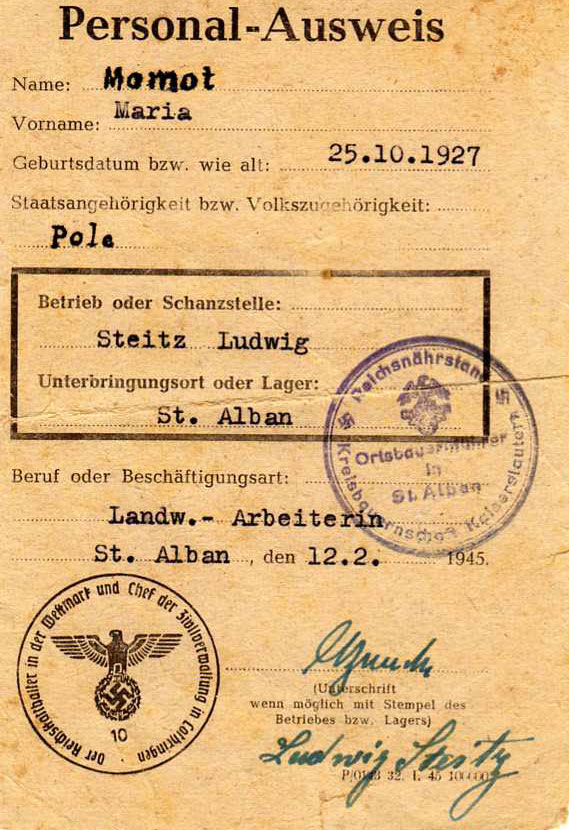
May 20, 2008
Hi Olga,
I
have sent you my mother's work card. She worked here as a farmworker St
Alban Kaiserslautern in 1945. Can't find any more information about this
place (also have a photo) again a lady in Australia who worked with Mum
at St Alban recognized the photo of Mum and a friend to be on this farm.
Regards Liz. Australia. lizzie.mick@bigpond.com
Stade
Stettin
Stolzenau
Stolzenau is a municipality in the district of Nienburg, in Lower Saxony, Germany. It is situated on the left bank of the Weser, approx. 20 km southwest of Nienburg, and 25 km northeast of Minden. Wikipedia
http://en.wikipedia.org/wiki/Stolzenau
http://streat.ca/stolzenau_cemetery
http://www.philasearch.comy
http://m.iwm.org.uk
"Belsen lay ahead of us
On 5 April, we found ourselves entering the small town of Stolzenau on the River Weser. The bridge was blown, so we had to force a crossing under cover of farm buildings on the opposite bank. The Royal Engineers tried to build a pontoon bridge, but they were badly mauled by shellfire and German aircraft bombing. I was told they lost 18 men, while our losses were something like 13, and other units had a few more."
http://www.bbc.co.uk
check out Stolzenau slave camps on google - lots of pages to explore
Jan 14, 2014
Hi
My brother-in-law was born in Stolzenau, Niedersachsen in either a concentration or slave labor camp in January 1945. The only camp I can find any reference to in that area is Belsen, do you know if there were other camps?
Ferdinand Vermaes was Dutch and immigrated to Australia in 1964 and died in 2006.
Ferdinand (he changed his name to Wess when he came to Australia) never spoke about anything to do with his life in Holland after the family immigrated to Australia. He married my sister Deborah 4 years after arriving here. I was only very young, and the subject of the war and Nazis always seemed to be whispered about when us kids were around. His mother said that she went into labor with Wess just after a bomb was dropped near the camp.
I hope you can help me. Thank you
Terry Allen allentaa31@gmail.com
Cairns, Qld, Australia
Struthof, France Also known as Natzweiler-Struthof, this concentration camp for men was established in May 1941 near Strasbourg in German-occupied France to hold prisoners from the occupied western European countries. Natzweiler and its surrounding subcamps held approximately 19,000 prisoners by the end of the war.
Stutthof, Poland
Located 25 miles east of Gdansk (Danzig), established on September 2,1939 as a prison camp for Polish men, since January 1941 also a forced labor camp for women. Since January 1942, Stutthof was a concentration camp with a complex of 146 subsidiary camps for prisoners from all over Nazi-occupied Europe. Conditions were extremely harsh. In summer 1944, mass murder by gassing began. A total number of 115,000 men, women and children were registered in Stutthof when evacuation and death marches began in January 1945. Less than 50,000 survived. The Soviet Army liberated Stutthof in April 1945.
In case anyone has a DP query relating to Soviet military HQ in Warsaw...your Stuthof Concentration Camp main correspondent gives the following info tref 1945 et passim .. 'the headquarters of Russian Security located in the building of the Directorate of the Wilenska Railway Station on the corner of Targowa and Wilenska streets'.
 Alan Newark /
Scotland
Alan Newark /
Scotland
"It was also the last camp liberated by the Allies, on May 9, 1945. The Nazi authorities of the Free City of Danzig were compiling material about known Jews as early as 1936, and also reviewing suitable places to build concentration camps in their area. The first prisoners were 150 Jewish Danzig citizens. Prisoners from other countries along the Baltic Sea were transported there in 1944. A large number of people have perished of hunger and frost on the roads and by British bombardment of refugee ships, during the Soviet conquest of eastern Germany. Stutthof was not mentioned in the Nuremberg trials. The inmate population rose to 6,000 in the following two weeks, on September 15, 1939, The "old camp" comprised eight barracks for the inmates and a "kommandantur" for the SS guards, totalling 12 ha. In 1942, a "new camp" was built with 30 new barracks, raising the total area to 120 ha. A crematory and gas chamber were added in 1943, just in time to start mass executions when Stutthof was included on the "Endlung" on June 1944. Mobile gas wagons were also used to complement the maximum capacity of the gas chamber (150 people per execution) when needed. There were 115,000 to 127,000 inmates interned at Stutthof from 1939 until its liberation by the Soviet army, with a total number of dead somewhere between 65,000 and 85,000 people, with 22,500 more that were moved to other camps as the Allied forces approached.These totals are thought to be conservative, as it is believed that inmates sent for immediate execution were not registered. The former prisoner of Stutthoff and Lithuanian writer Balys Sruoga wrote afterall a novel Diev? mi?kas (The Forest of Gods) describing the everyday life of this camp." from http://en.wikipedia.org
Another death march: Kz monument Surberg were 61 Jewish POW's were shot by their guards 3 May 1945.
On 3. May 1945 wurden kurz vor Kriegsende an einem Waldrand nahe Surberg
(Wüstenreit)
61 Häftlinge eines Todesmarsches http://de.wikipedia.org aus
dem KZ Flossenbürg http://de.wikipedia.org von
ihren Wachmannschaften erschossen. Eine jüdische Gedenkstätte
(Chanukkaleuchter) bei Surtal erinnert an das Massaker.
Provided by Anthony Schlega schlega.a@web.de
Swietochlowice-Zgoda
Dear Ms. Kaczmar,
I writing to you seeking advice on locating a list of prisoners of the Swietochlowice-Zgoda labor camp, during the German occupation and also the period just following the war, when it was under Russian occupation.
My mother, Therese Maria Straszek, was born in 1933 in western Poland, in the town of Swietochlowice, near the camp, and we believe they lived in this area during the Nazi occupation. We know little of her story during the war years; she died in 1973 at age 40 and talked little of that period. However, I and my siblings recall various stories of she and her mother being put into a labor camp for some period near the end of the war or just after the Russians invaded.
Also, we know that by 1950, she and her mother were living in Giessen, Germany, as German citizens, but we do not know the circumstances that brought them there. In my research, I discovered some writings about locals of the Swietochlowice area being forced into the labor camp under the Nazis, but also, the Russians interring those of German heritage or that remained passive during the Nazi occupation...
I also believe that some of these prisoners were deported to Germany after the closure of the camp late in 1945, which would be consistent with their move to Giessen. In any event, I am wondering if any list of prisoners of Swietochlowice - Zgoda under the Germans or Russians exist and are they accessible. Thanks for any help you can provide in this matter.
All the best, Mike
Mike Polcyn mpolcyn@mail.smu.edu
Continue to slave camps T-Z