Page Two
by C. Maihoefer, / Germany, 2003
UNRRA
Team 509 - Ulm:
R. Nowicki
J. Kelly
J. Gambus
A. Van Binsbergen
P. Worthington
J. Nowicki
A. Meoller
Transportation: 'Transport' was one of the words of the Nazi language common to all victims of the regime. One of the strangest facts in the after war history was the ongoing practice of sending the displaced persons on transports to unknown destinations and with bewildering arbitrariness.
Ulm, with its large DP population and its railway connection, played its role in this system of transportation. Three examples will show this now forgotten hardship of DP life.
1949 a lot was done by the IRO to 'restructure' the DP world. Remember that the IRO itself was an attempt to restructure the work with the refugees started by the UNRAA since 9. 11.1943!
In November 1949 a group of 500 Ukrainians were send on a transport from Regensburg to Ulm to live there in the large Sedan Barracks. Among them was Professor Mikola Zajcew. The group was well organized, and soon established an academy in Sedan. But their work was done in vain: In January 1950, the Ukrainians were again transported; this time to Ellwangen, 70 kilometers north of Ulm. The Ukrainians protested in public against this treatment, but their protest did not show any effects. Professor Zajcew's aim was to bring his academy over to the United States. Who knows what happened to this project?
Education: During the time of the occupation, millions of people in Europe had no chance for proper education or vocational training, and who could think about scientific work in time of the persecution? A generation stood there on the doorstep of their future in the need of the tools for it. But who could think about a proper education or vocational training in the DP camps, under the condition of being sent from one camp to another without being asked?
In April 1949 a group of 375 Jews left the DP camp in Eschwege to make 'alija' (to go to Israel). They were free people. But when their train arrived in Ulm, they were asked to go into the DP barracks. The Jews were not willing to follow this order. Why should they do this? For 34 hours they did strike in the wagons. Then they were forced by armed military police to leave the train and they were brought to the Hindenburg barrack (another large DP camp in Ulm). A photograph documents this event in 49, showing the row of military police at the train, not at the regular railway station, but at the ramp.
 The end of the Jewish DP camps in Ulm was marked by the same treatment. In August '49, rumors went through Sedan, that all Jews would be send on transport to camps in Bavaria. This meant, among other hardships, that the people, who came to Ulm around summer '46, could not complete their educational programs. The DPs protested against this treatment and wrote a note to General Greenstein, who was at that time the Jewish advisor in Frankfurt. They also wrote to the IRO headquarters, but the effect was negative. Although they could even show the low standard of the camps by photographs of Fohrenwald and Gabersee, the destinations of the transports. Even the support of citizens of Ulm made no difference. On the first of September, vans took the sick and disabled first, and brought them to the ramp, where the trains were ready. This was recorded in the newspapers of Ulm, September '49, by a German journalist who saw in this treatment an act of arbitrariness.
Also, DPs were deeply frustrated by the slowness of the UNRRA, and later by the IRO. The Polish DP newspaper Kronica December 1947 showed a cartoon with its opinion about the 'DP train'. Maximilian Pleczko was named in the same newspaper as a journalist of the 'Kronika' in Ulm. One should write the history of the DP journalism.
This year one of my activities was to work with a Jewish woman on her history. I visited her in Israel, and she came to me to learn about Ulm, where she was born in 47, child of DPs. We walked the old places, and I showed her the house, where they once lived, the grave yard, the camp. Her parents died early, and she knows so little about her past. We put together the puzzles, and I hope, we will bring this to an end. I got pictures from her, from which we could identify the flat. And all puzzles can be of worth for those who know less.
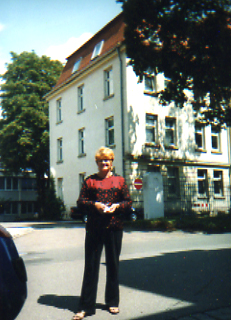
Olga Kaczmar (above) in front of DP camp building in Ulm. It is the entrance of the camp Sedan-Kaserne, from 1946- 1949 held Jewish DPs, later a.o. Ukrainian
My family (Brukman) was in Ulm in 1949. I was born there. How can I obtain information about the DP Camp that was housed there? Lee Brukman
2/11/05
I came to the US with my parents and a brother and sister. We were one of the fortunate ones that created another life after spending time in the DP camps in Germany. The two camps I remember the most were Valka and Ulm. We came to the US without any other family and friends so in the grand scheme of things it was a frightening experience to be all alone in a strange land without knowing the language.
Now I'm retired and have the time to reminisce and perhaps put my life into words so that it can be shared with my family who knows very little about my life before we came to the US. I don't know exactly what I'm looking for other than perhaps communicate with others who have had similar experiences.
Respectfully, John Plumitis
7/28/05
I was doing a search about my old Army unit in Neu Ulm, Germany and came upon your site. I spent over 4 years there from 87-91 and never heard of the story of the DP camps there. I visited the city museum of Ulm during my stay there and don't remember any mention of it. Information related to Ludendorf Kaserne and role of US Army would would be most helpful. Please keep up the good work. Thank you. Jason Unwin, USA
On 7/1/11
Hi Ms. Olha Kaczmar, I heard of you and your work
through Anton Schlega. He suggested that I send this little tale to you
directly. At the moment I live in northeastern Brazil, but I grew up
in the
States.
I am an ex- DP person. As I remember, we lived in an actual camp when my Mom reached Germany on foot (with 2 kids - my 6 mo. old sister and me - a little over 2). My mother set out from Ukraine with two men that my father thought could be trusted to help her on the way. It turned out they actually were planning to rape and rob her. When she overheard this she escaped and continued on her own. I have a description she wrote about them - she was very hurt and angry.
I am trying to remember what place it was in Germany. Then when my Dad managed to get out of jail in Ukraine and escape on bicycle (I know he did this with Ivan Tyktor - historian and publisher). He spent over a year , maybe 2 to find us.
The first place that I have real memory of - is in Ulm (Donau). We stayed in a building (apt.) that was requisitioned for DP families from some German. I know that my father felt that he should pay some kind of rent to this man. I remember going with him once to do so - it was in a bombed house, with blankets used substituting a wall, and an old couple was sitting all wrapped up in there. My father gave him something and they talked for a little while - I know that my father spoke some German.
In the building we lived there was a German family living in the attic with a little boy. I have fond memories of playing with Bubbi. My parents maintained their contact with the mother - Frau Glassbrenner for many years - even when we lived in the States.
Then we moved to Munich and lived in an apt block , on the outskirts of the city on Aingerstrasse - lots of bomed buildings around. In the sixties, I visited the place - many buildings were built up around the area. But even then there were still some Ukrainians living there. My father taught after the war in an UNRRA school . He would take a train and spend most of the week there - I think it was in Murnau. I know that when my mother had to have an operation - my sister and I were placed in an orphanage in Mittenwald for a few weeks or months. - Don't remember now. My father visited us there a few times - I remember that this was a beautiful place, but I could not understand anyone and was shocked by sleeping in a large hall with many other children. I have a couple of pictures from there. We moved to the States in 1950 when I turned 7.
I am glad that you and others are digging into this - it is hard to track - but I think it is important for many people to discover the stories of the past. Towards the end of the journey she encountered and was helped by a Lithuanian family. They eventually ended up in Autralia. I´ve had contact with them all of these years. Their daughter Elvira saved my life. Many years later she came to visit me in Brazil. She became a doctor in Sydney.
There are so many stories that are still to be told. I don't know what exactly you are doing and what type of info you are collecting. I will be glad to tell you more should it be of interest.
Thanks for your work.
Margarita mrita285@yahoo.com